
Functional Skills English Level 2 covers three areas: reading, writing, and speaking, listening and communicating. You need to pass all three to get the qualification. The topics range from comparing texts and spotting bias to writing a formal email without a spellchecker and holding your own in a group discussion.
Many adults take this qualification because a job, apprenticeship or course asks for a Level 2 English qualification and they don’t have a GCSE at grade 4 or above. Knowing exactly what you’ll be tested on makes revision much less stressful.
This guide takes each official Functional Skills English Level 2 topic and explains it in plain English, with short examples of what it looks like in practice. If you need maths too, our guide to Level 2 maths and English topics covers both subjects and how to prepare.
Ready to Build Your Maths and English Skills?
Strengthen your understanding of essential Maths and English topics with a flexible online course. Study fractions, percentages, ratios, grammar and punctuation at your own pace while preparing for your next learning goal.
What topics are in Functional Skills English Level 2?
The Department for Education’s official subject content for English sets out 28 skills at Level 2. Every awarding organisation must cover them. They’re split across three components:
| Component | Skills at Level 2 | What it tests | Who sets the assessment |
|---|---|---|---|
| Reading | 9 | Understanding, comparing and judging texts | The awarding organisation |
| Writing | 9 (3 spelling, punctuation and grammar, 6 composition) | Writing clear, accurate, well-organised text | The awarding organisation |
| Speaking, listening and communicating | 10 | Discussions, explanations and presentations | The awarding organisation, your centre or both |
This subject content applies to England. Wales, Northern Ireland and Scotland have their own adult literacy qualifications, so check your local framework if you live outside England.
Reading topics
The reading component checks whether you can understand what a text says, how it says it and why. At Level 2, the texts can be long and cover technical or abstract subjects.
Finding and using information
You need to judge when the main points are enough and when you need specific details. You’ll also use a text’s structure, such as headings, contents pages, glossaries and keys, to find information quickly.
Example (for illustration only): a question might ask which section of a leaflet explains how to make a complaint, and what the deadline is.
Comparing texts
You’ll often read two or more texts on the same subject and compare the information, ideas and opinions in them. The key detail at Level 2 is comparing how each writer gets their message across, not just what they say. One article might use statistics while another relies on personal stories.
Implicit meaning, fact and opinion
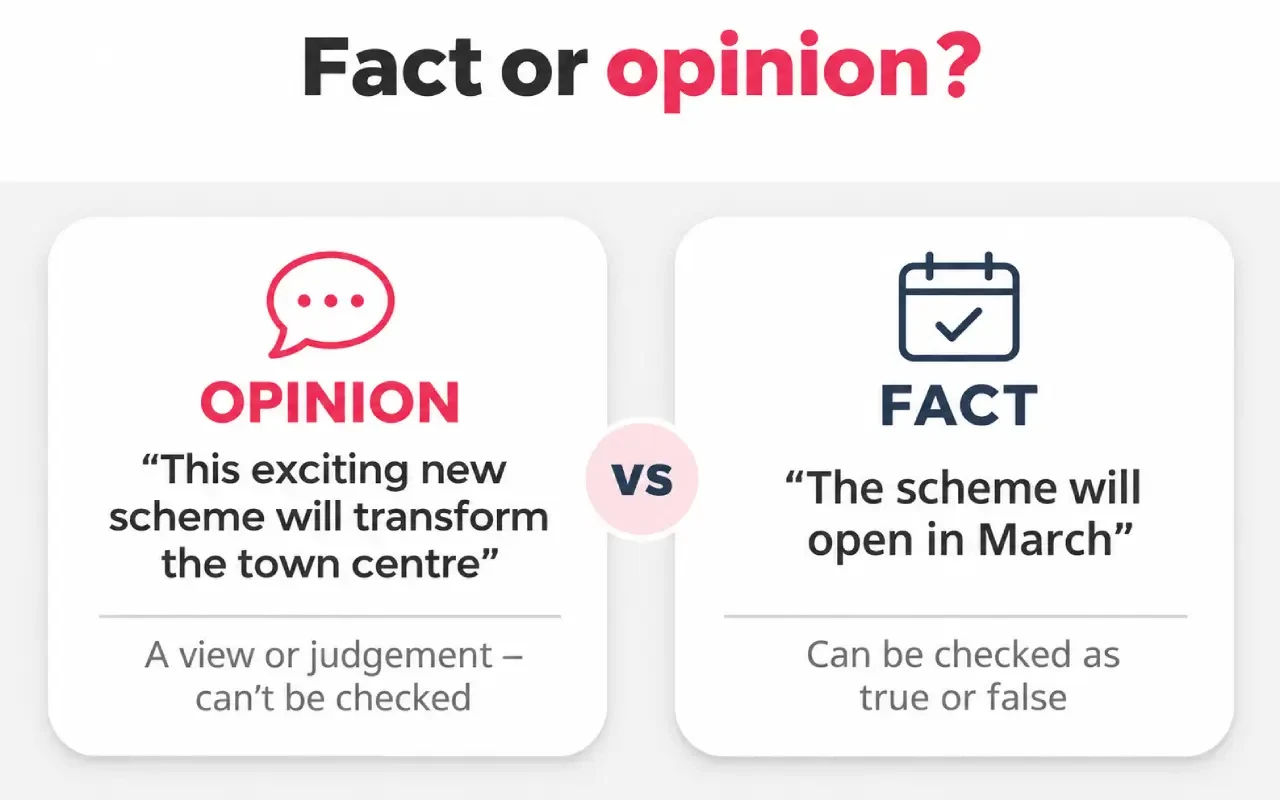
Not everything is stated directly. You’ll need to read between the lines to pick up what a writer implies. You’ll also follow an argument, identify different points of view and separate facts (which can be checked) from opinions (which can’t).
Example (for illustration only): “This exciting new scheme will transform the town centre” is an opinion. “The scheme will open in March” is a fact.
Language, formality and bias
This topic covers the choices a writer makes:
- Presentational features: headings, bullet points, images and bold text, and how they shape meaning.
- Language features: vocabulary, rhetorical questions, emotive words and specialist terms.
- Formality and bias: whether a text is formal or informal, and whether it presents a one-sided view.
- Style and voice: recognising different styles of writing and the writer’s own voice.
Writing topics
The writing component has two parts: getting the technical accuracy right, and putting together writing that suits its purpose and reader.
Spelling, punctuation and grammar
At Level 2, you’re expected to:
- Punctuate correctly using a wide range of marks, including colons, commas, inverted commas, apostrophes and quotation marks.
- Use correct grammar, including subject–verb agreement (“the team is”, not “the team are” in formal writing), consistent tenses, articles (“a”, “an”, “the”) and modal verbs such as might, should and must.
- Spell accurately, including the specialist words used in work, study and daily life.
This part catches many learners out. Under Ofqual’s rules for Functional Skills English, you can’t use a dictionary or spelling and grammar checking software during the writing assessment. If you normally rely on autocorrect, practise writing without it well before exam day. A self-paced online course in grammar and punctuation is one way to work on these skills.

Writing for purpose and audience
Every writing task has a reader and a reason. You’ll need to:
- communicate information, ideas and opinions clearly and logically
- include the right amount of detail and write to any length given
- choose suitable language and register, for example formal for a complaint letter and more relaxed for a message to a colleague
- use persuasive techniques and supporting evidence where the task calls for them
Example (for illustration only): you might be asked to write an email to your local council arguing for better street lighting, using reasons and evidence.
Structure and organisation
Good writing is easy to follow. At Level 2, this means:
- Using the right format, such as a letter, email, report or article, with features like paragraphs, bullet points or tables where they fit.
- Using organisational markers, linking words and phrases such as however, as a result and in addition, so your points connect.
- Writing complex sentences accurately and consistently.
Speaking, listening and communicating topics
This component is often called SLC. It tests how well you communicate when speaking and listening to others, and it has the most skills of the three: 10 in total.
Listening and responding
You’ll need to:
- pick out relevant information from long explanations or presentations
- follow stories and lines of argument
- respond well to detailed questions and feedback
- ask clear, specific questions to get the information you need
Speaking and taking part in discussions
You’ll also need to:
- communicate information, ideas and opinions clearly, adding detail when needed
- support your opinions with relevant, persuasive evidence
- use language that suits the situation
- make useful contributions that move a discussion forward
- adapt what you say to your audience, purpose and setting
- interject and redirect a discussion politely, for example “Can I come back to the cost for a moment?”

How SLC is assessed: Ofqual requires the component to be assessed using more than one task. These can be set and marked by your centre, within rules set by the awarding organisation. The subject content refers to discussions, detailed explanations and presentations. Exact formats vary, so ask your centre what your SLC tasks will involve.
How Level 2 differs from Level 1
If you’ve already passed Level 1, or you’re deciding where to start, here are the main differences in the official content:
| Area | Level 1 | Level 2 |
|---|---|---|
| Texts | Varying lengths | Extended texts, including technical and abstract topics |
| Reading skills | Main points, fact and opinion | Adds implicit meaning, bias, formality and the writer’s voice |
| Punctuation | A range of punctuation | Adds colons, inverted commas and quotation marks |
| Grammar | Correct grammar | Adds modal verbs |
| Writing | Clear, organised text | Adds persuasive techniques, organisational markers and consistent complex sentences |
| Discussions | Taking part and contributing | Adds interjecting, redirecting and moving discussions forward |
How the topics are tested
Ofqual sets the assessment rules that every awarding organisation must follow:
- Reading and writing are each tested in a single assessment set by the awarding organisation.
- Speaking, listening and communicating is assessed separately.
- The total assessment time is between two and three hours, though each awarding organisation decides how that time is split across the components.
- You must pass all three components at the same level.
Functional Skills Level 2 sits at the same qualification level as GCSE grades 9 to 4. Pass marks aren’t fixed nationally, so check the pass marks set by each awarding body before you book.
How to revise the topics
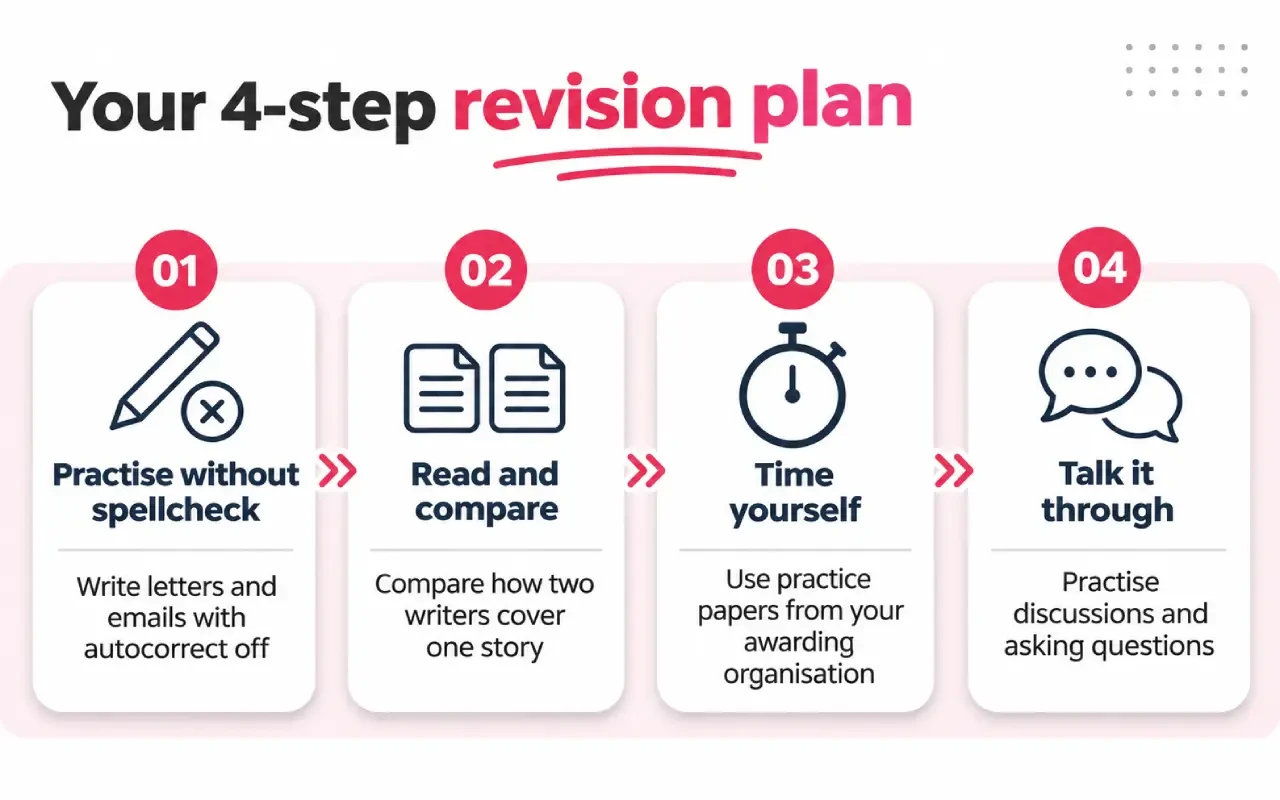
Your best revision tool is the official list of skills. Use it as a checklist and tick off each one when you feel confident. Then:
- Practise without spellcheck. Write emails, letters and short reports by hand or with autocorrect switched off.
- Read and compare. Take two news articles on the same story and note how each writer presents it.
- Time yourself. Use practice papers from your awarding organisation so the exam format feels familiar.
- Talk it through. Join discussions at work, in study groups or with friends, and practise asking questions and politely steering the conversation.
If the reading tasks feel daunting, this honest look at how hard Level 2 is may put things in perspective. It also helps to plan how long to prepare around work and family commitments. Studying alone can be hard going, so these tips for staying motivated online may help too.
Where Course Gate’s course fits: Course Gate’s Functional Skills English Level 2 course is a self-paced, CPD-accredited online course covering grammar, sentence structure, questions, punctuation and capitalisation, spelling and common mistakes. It includes a short mock test and a final course test, and you can get a CPD certificate from Course Gate when you complete it. It’s important to be clear about what it isn’t: it is not the Ofqual-regulated Functional Skills qualification, it doesn’t include the official exam, and it doesn’t cover the reading or SLC topics. It works best as extra practice on spelling, punctuation and grammar alongside past papers and your chosen exam centre. If you need both subjects, the combined maths and English Level 2 course covers maths topics too.
Next steps
Functional Skills English Level 2 rewards steady, focused practice more than cramming. Download your awarding organisation’s specification, compare it with the topics above, and mark the ones that need work. Then take a timed practice paper to see where you stand. That gives you a clear plan instead of a long, vague revision list.
Frequently asked questions
How many exams are there for Functional Skills English Level 2?
There are three components: reading, writing, and speaking, listening and communicating. Reading and writing are separate assessments set by the awarding organisation. SLC is assessed through more than one task. You need to pass all three.
Is Functional Skills English Level 2 hard?
It depends on your starting point. The content is practical and focused on real-life tasks, but Level 2 expects accurate writing and careful reading of longer texts. Working through each topic steadily makes a big difference.
What is the pass mark for Functional Skills English Level 2?
There’s no single national pass mark. Each awarding organisation sets its own, and it can vary between exam papers. Check with your awarding organisation or exam centre.
Can I use a dictionary in the Functional Skills English Level 2 exam?
Not in the writing assessment. Ofqual’s rules don’t allow dictionaries or spelling and grammar checkers there, because the assessment tests your own spelling, punctuation and grammar.
Can I do Functional Skills English Level 2 online?
Yes, you can study online, and some exam centres offer online assessments with remote invigilation. Availability depends on the awarding organisation and centre, so confirm the arrangements before booking.
What happens if I fail Functional Skills English Level 2?
You can resit. Retake rules, fees and waiting times vary by centre and awarding organisation, so ask your provider. Use your results to focus revision on the topics that held you back.


- All Courses
- Accounting & Finance64
- Admin, Secretarial & PA45
- Audio Books (Audio Course)100
- Business Skills159
- Design76
- Digital Marketing49
- DIY (Do It Yourself)60
- Employability245
- Food Hygiene & Safety18
- Health & Fitness68
- Health & Safety114
- Health & Social Care191
- Human Resource51
- It & Software Skills116
- Language27
- LIFESTYLE88
- MAKEUP & BEAUTY49
- Management132
- Marketing63
- Massage & Physiotherapy18
- Microsoft Office64
- Nonprofit & Charity36
- On Demand Courses54
- Personal Development142
- Photography34
- Psychology & Counselling99
- SEN (Special Educational Needs)24
- Teaching and Education100