
Choosing between Level 2 and Level 3 teaching assistant training can be confusing, especially when course titles and school job descriptions use similar wording.
The main difference between Level 2 and Level 3 teaching assistant qualifications is the depth of knowledge and skills assessed. Level 2 generally focuses on foundational classroom support, while Level 3 develops more advanced learning support skills. However, responsibilities and salaries depend on the school, job description and experience, not simply the qualification level.
So, which should you choose? Understanding the differences in duties, training and career opportunities will help you make a more informed decision.
Not sure which level fits you? Take our 1-minute Level 2 or Level 3 quiz.
Considering Level 3 Teaching Assistant Training?
Build your classroom support and SEN knowledge with Coursegate's flexible Level 3 Teaching Assistant & SEN Certificate.
- Teaching assistant responsibilities and classroom strategies
- Supporting pupils with special educational needs (SEN)
- About 3 hours 55 minutes of learning, study at your own pace
Level 2 vs Level 3 Teaching Assistant: Key Differences
Both levels can support a career in education, but they serve different learning needs.
| Comparison | Level 2 Teaching Assistant | Level 3 Teaching Assistant |
|---|---|---|
| Qualification level | Comparable in level to GCSE grades 4–9 | Comparable in level to A levels |
| Learning focus | Foundational classroom support | More advanced learning support |
| Typical duties | Assisting teachers and supporting pupils | May include targeted interventions and additional responsibilities |
| Entry requirements | Vary by programme | Vary by programme; Level 2 is not always required first |
| SEN/SEND support | Foundational support for different learning needs | May involve more detailed specialist knowledge |
| Salary | Depends on employer, grade and hours | Depends on employer, grade and hours |
| Career progression | Can support entry-level opportunities and further study | Can support progression towards specialist or more demanding roles |
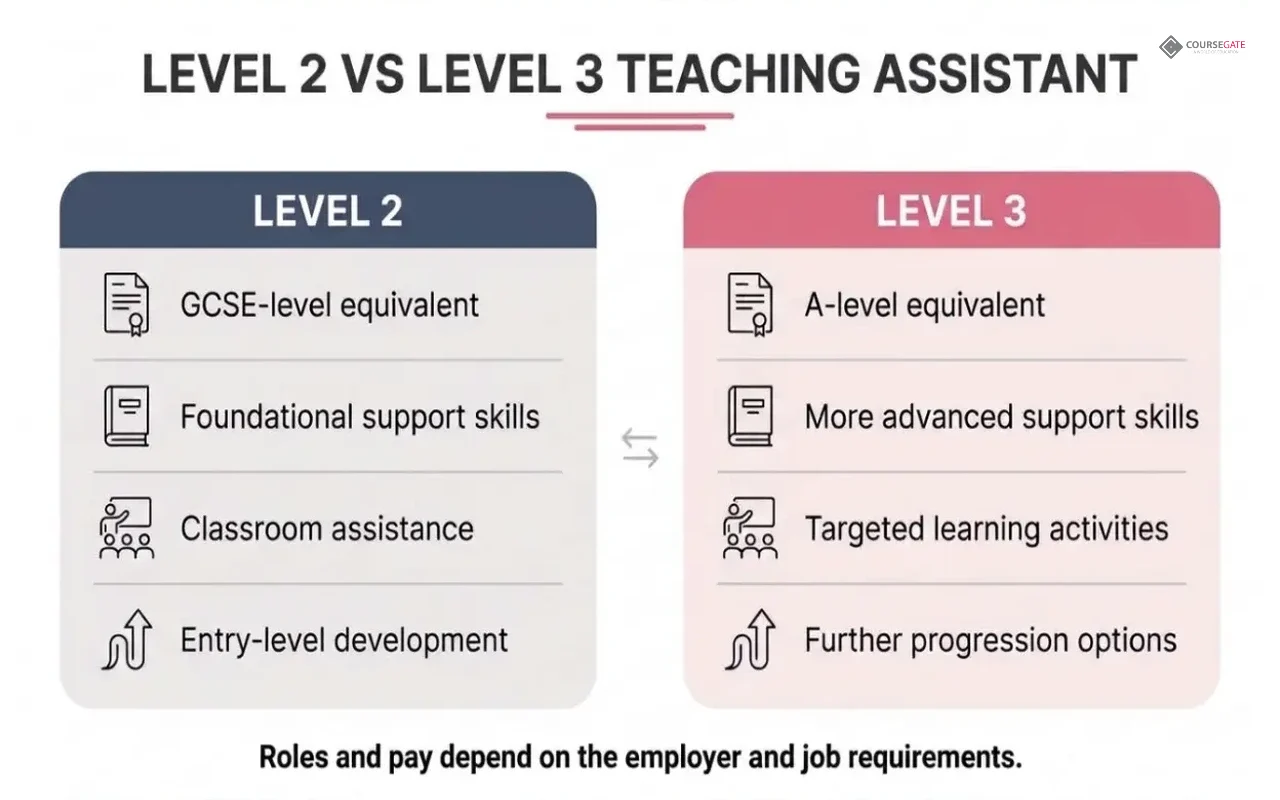
According to the government’s UK qualification levels, Level 2 and Level 3 represent different levels of learning. However, being at the same level as a GCSE or A level does not mean a vocational qualification covers the same subjects.
It is also important to distinguish qualification levels from school job grades. A Level 3 qualification does not automatically place someone in a higher-paid position.
If you are considering further study, understanding your options for choosing a Level 3 teaching assistant certificate can help you identify the appropriate training route.
How Do Level 2 and Level 3 Teaching Assistant Responsibilities Differ?
Teaching assistants support teachers and pupils, but the complexity of their work can vary according to the position.
Typical Level 2 Teaching Assistant Duties
Level 2 training generally develops the foundational skills needed for classroom support.
Typical responsibilities may include:
- Preparing learning materials and classroom resources.
- Helping pupils complete activities planned by teachers.
- Supporting individual pupils or small groups.
- Encouraging positive behaviour and classroom participation.
- Sharing observations about pupils' progress with teachers.
For example, a teaching assistant might help a small group practise reading while the teacher works with the rest of the class.
Typical Level 3 Teaching Assistant Duties
Level 3 training generally develops more advanced knowledge of learning support, pupil development and classroom practice.
Depending on the role, responsibilities may include:
- Delivering structured learning interventions.
- Supporting pupils with special educational needs and disabilities (SEND).
- Adapting activities to meet different learning needs.
- Monitoring progress and communicating observations.
- Taking greater responsibility for particular learning activities.
The National Careers Service outlines these broader teaching assistant duties.
The distinction is not absolute. An experienced Level 2-qualified teaching assistant may perform duties similar to those of someone holding a Level 3 qualification.
Schools determine responsibilities according to job requirements, staff competence and appropriate supervision.

What Is the Difference Between Level 2 and Level 3 Teaching Assistant Training?
The most important training difference is not simply the course title. It is what the programme teaches, assesses and awards.
Qualification Level and Learning Requirements
Level 2 programmes generally introduce classroom support, communication, safeguarding awareness and supporting learning activities.
Level 3 programmes may explore these areas in greater depth, including planning support activities, monitoring progress and responding to individual learning needs.
However, not every course advertised as Level 3 awards a regulated Level 3 qualification.
The distinction matters:
- Regulated qualification: A qualification awarded through an appropriate regulated awarding organisation, with specified learning and assessment requirements.
- CPD or course completion certificate: Evidence of completing professional development or training, which does not automatically represent a regulated qualification.
Ofqual’s regulated qualification descriptions help explain how different qualification types are classified.
For a broader explanation of teaching assistant qualification requirements, readers should check the qualifications expected by their preferred employers.
Can You Start Level 3 Without Completing Level 2?
Yes, some Level 3 teaching assistant programmes allow direct entry without a Level 2 qualification.
However, entry requirements vary. Some programmes may expect previous experience, particular English and maths skills or access to a school placement.
Always check the specific programme requirements rather than assuming that Level 2 is compulsory or unnecessary in every case.
How Long Does Teaching Assistant Training Take?
Training duration depends on the type of programme.
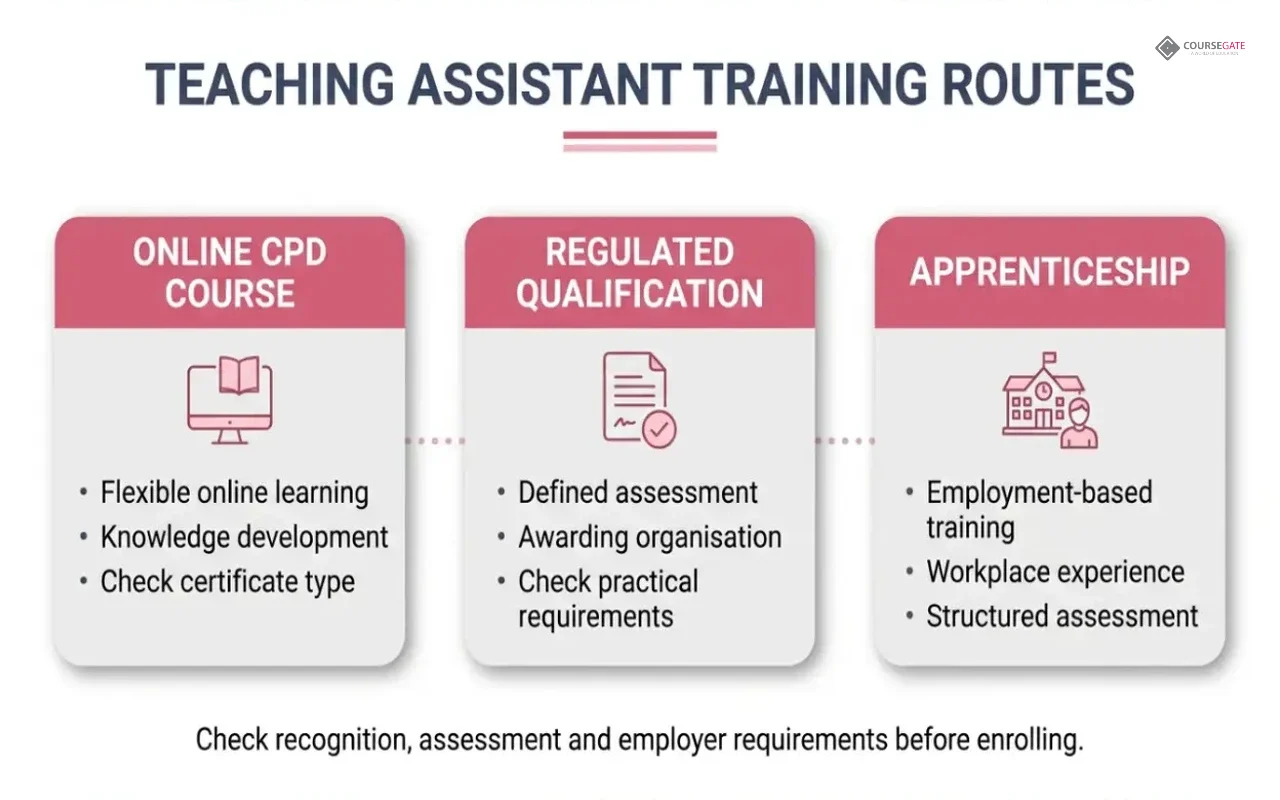
A short online course may take only several hours, while a regulated qualification involving workplace assessment can take considerably longer.
A Level 3 teaching assistant apprenticeship is another route, combining employment with structured learning and assessment.
If flexibility matters, understanding studying a teaching assistant course online can help you evaluate delivery methods, assessment and recognition.
Do Level 3 Teaching Assistants Earn More Than Level 2?
Level 3 teaching assistants may earn more when they move into roles involving greater responsibility. However, holding a Level 3 qualification does not automatically increase your salary.
Pay depends on factors such as:
- The school's salary structure and employer.
- Responsibilities and job grade.
- Relevant experience and specialist skills.
- Working hours and contract arrangements.
Teaching assistant vacancies may advertise full-time equivalent (FTE) salaries. Staff working term-time-only or part-time contracts may receive a lower actual annual salary.
For context, the National Careers Service lists typical teaching assistant salaries from £19,000 for starters to £26,000 for experienced workers. These are general career figures, not separate Level 2 and Level 3 pay scales. Actual earnings may be lower for part-time or term-time-only contracts.
A school support-staff Grade 5 is also not the same as a Level 5 qualification.
For a more detailed breakdown, explore Level 3 teaching assistant salary information, including pay scales and contract considerations.
Should You Choose Level 2 or Level 3 Teaching Assistant Training?
The better option depends on your experience, learning goals and the requirements of the roles you want to pursue.
Level 2 or Level 3? Find Your Teaching Assistant Starting Point
Answer five quick questions to see which level may suit your experience and goals.
When Level 2 May Be a Better Starting Point
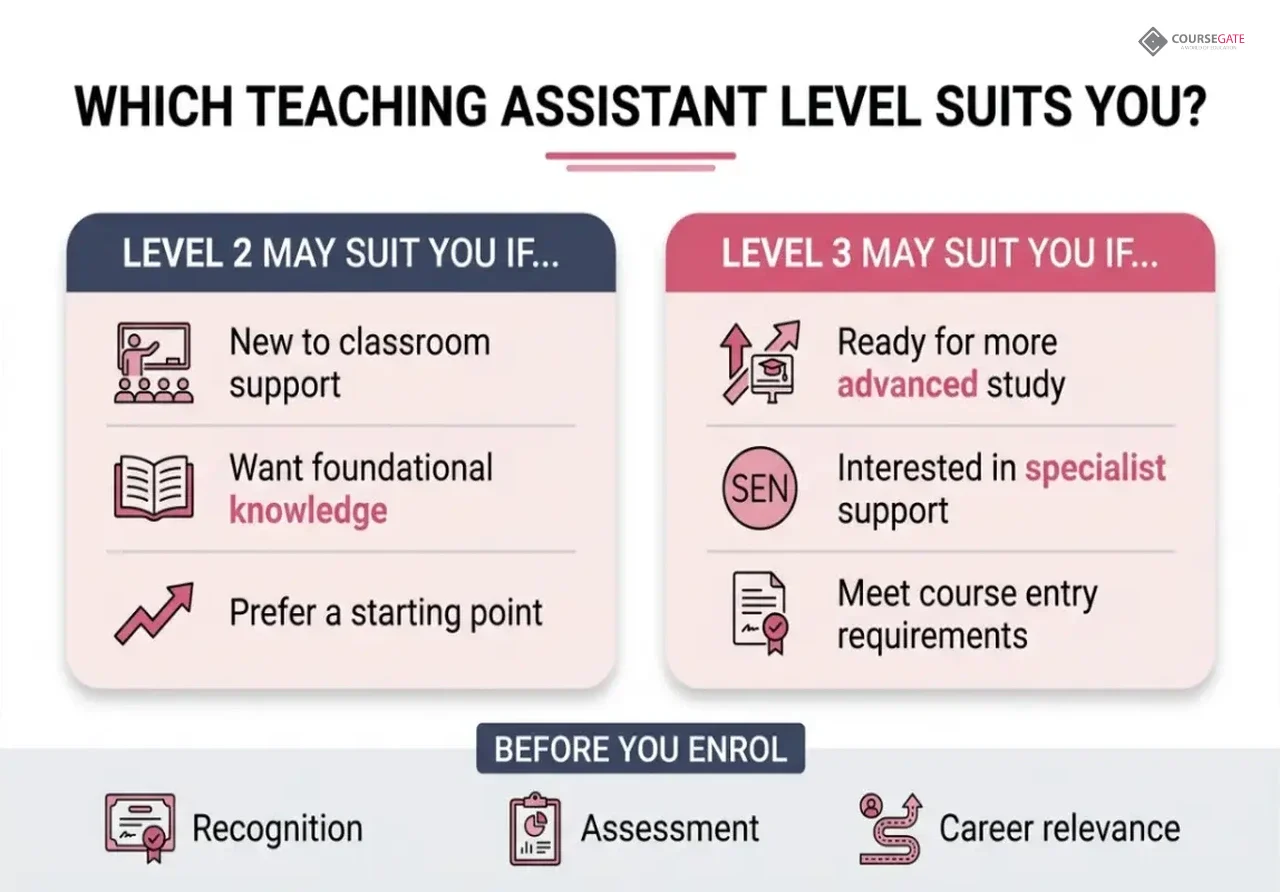
Level 2 may suit you if you:
- Are new to working in education.
- Want to develop foundational classroom support knowledge.
- Prefer to build confidence before more advanced study.
- Are exploring entry-level teaching assistant opportunities.
It can provide a structured introduction without requiring you to begin with more advanced learning.
When Level 3 May Be More Suitable
Level 3 may be appropriate if you:
- Already have classroom or relevant support experience.
- Want to develop more advanced learning support skills.
- Are interested in specialist SEN/SEND support.
- Meet the entry requirements of a suitable Level 3 programme.
Some learners may be ready to begin Level 3 directly. Others may benefit from starting with Level 2.
Three Checks Before Enrolling
Before choosing a course, consider:
- Recognition: Does the programme award a regulated qualification, an apprenticeship outcome or a CPD certificate?
- Assessment: Does it require practical workplace evidence, a school placement or online assessments?
- Career relevance: Does it meet the requirements stated in the school vacancies you are interested in?
For example, the official Level 3 Teaching Assistant apprenticeship standard sets out occupational knowledge, skills and behaviours for that particular training route.
Checking these details helps you choose training that supports your intended next step.
Explore Level 3 Teaching Assistant and SEN Training with Coursegate
If you want to develop your classroom support and SEN knowledge, Coursegate offers a Level 3 Teaching Assistant & SEN Certificate.
This CPD-accredited online course covers teaching assistant responsibilities, classroom strategies, professional standards and supporting pupils with special educational needs. It includes approximately 3 hours and 55 minutes of learning content, with one-year access.
A CPD certificate is available separately after successful completion, subject to the provider’s current terms. The course should not be treated as an Ofqual-regulated Level 3 qualification or a guarantee of employment.
Ready to Build Your Classroom Support and SEN Knowledge?
Learn online, at your own pace, with one-year access to the full course.
- Teaching assistant responsibilities and classroom strategies
- Supporting pupils with special educational needs (SEN)
- About 3 hours 55 minutes of learning, study at your own pace
Conclusion
Choosing between Level 2 and Level 3 teaching assistant training depends on your experience, learning needs and career plans.
Level 2 generally develops foundational knowledge, while Level 3 provides opportunities for more advanced learning. Neither automatically determines your job responsibilities or salary.
Before enrolling, check the course’s recognition, assessment requirements and relevance to your preferred school roles. The right choice is the one that supports your next step.
Frequently Asked Questions
Is Level 3 Teaching Assistant Harder Than Level 2?
Generally, Level 3 involves more advanced learning than Level 2. However, difficulty depends on the programme, assessment requirements and your previous experience. Learners with classroom experience may find some topics more familiar.
Is a Level 3 Teaching Assistant Qualification Equivalent to A Levels?
A regulated Level 3 qualification is at the same qualification level as A levels in England. However, this does not mean the qualifications have identical content, assessment methods or academic purposes.
Can a Level 3 Teaching Assistant Cover a Class?
A Level 3 qualification alone does not automatically authorise someone to cover classes independently. Schools must consider the person's role, competence, supervision arrangements and applicable requirements when assigning responsibilities.
Can You Become a Teaching Assistant with Level 2?
Yes, Level 2 training may support applications for teaching assistant positions. However, schools establish their own recruitment criteria, and some roles may require additional experience or qualifications.
What Comes After Level 3 Teaching Assistant Training?
Possible next steps include specialist SEND training, further professional development and progression towards Higher Level Teaching Assistant (HLTA) responsibilities. HLTA status is distinct from simply completing a Level 3 course.


- All Courses
- Accounting & Finance64
- Admin, Secretarial & PA45
- Audio Books (Audio Course)100
- Business Skills159
- Design76
- Digital Marketing49
- DIY (Do It Yourself)60
- Employability245
- Food Hygiene & Safety18
- Health & Fitness68
- Health & Safety114
- Health & Social Care191
- Human Resource51
- It & Software Skills117
- Language27
- LIFESTYLE88
- MAKEUP & BEAUTY49
- Management132
- Marketing63
- Massage & Physiotherapy18
- Microsoft Office64
- Nonprofit & Charity36
- On Demand Courses54
- Personal Development142
- Photography34
- Psychology & Counselling99
- SEN (Special Educational Needs)24
- Teaching and Education100