
Plenty of adults reach their 30s, 40s or 50s without a maths or English pass from school, and then find a job, an apprenticeship or a course asking for one. The good news is that you don’t have to go back and sit GCSEs.
Functional Skills are practical maths and English qualifications designed for adults. Level 2 is the highest level, and it sits at the same level as GCSE grades 9 to 4. You study with a college or online provider, then pass exams set by an approved awarding body. In England, many adults can study for free.
This guide covers who Functional Skills are for, what the Level 2 exams involve, how to check whether you can study for free, and how to prepare well, so you can choose the route that suits your life and budget.
Ready to Build Your Maths and English Skills?
Strengthen your understanding of essential Maths and English topics with a flexible online course. Study fractions, percentages, ratios, grammar and punctuation at your own pace while preparing for your next learning goal.
What are Functional Skills for adults?
Functional Skills are qualifications in maths and English that focus on using these skills in everyday life and work. Instead of abstract theory, you practise the tasks you actually meet as an adult, such as:
- working out a budget, a discount or a pay rise as a percentage
- reading a timetable, a chart or a workplace policy and picking out the key facts
- writing a clear, formal email or letter of complaint
- explaining an idea or taking part in a discussion
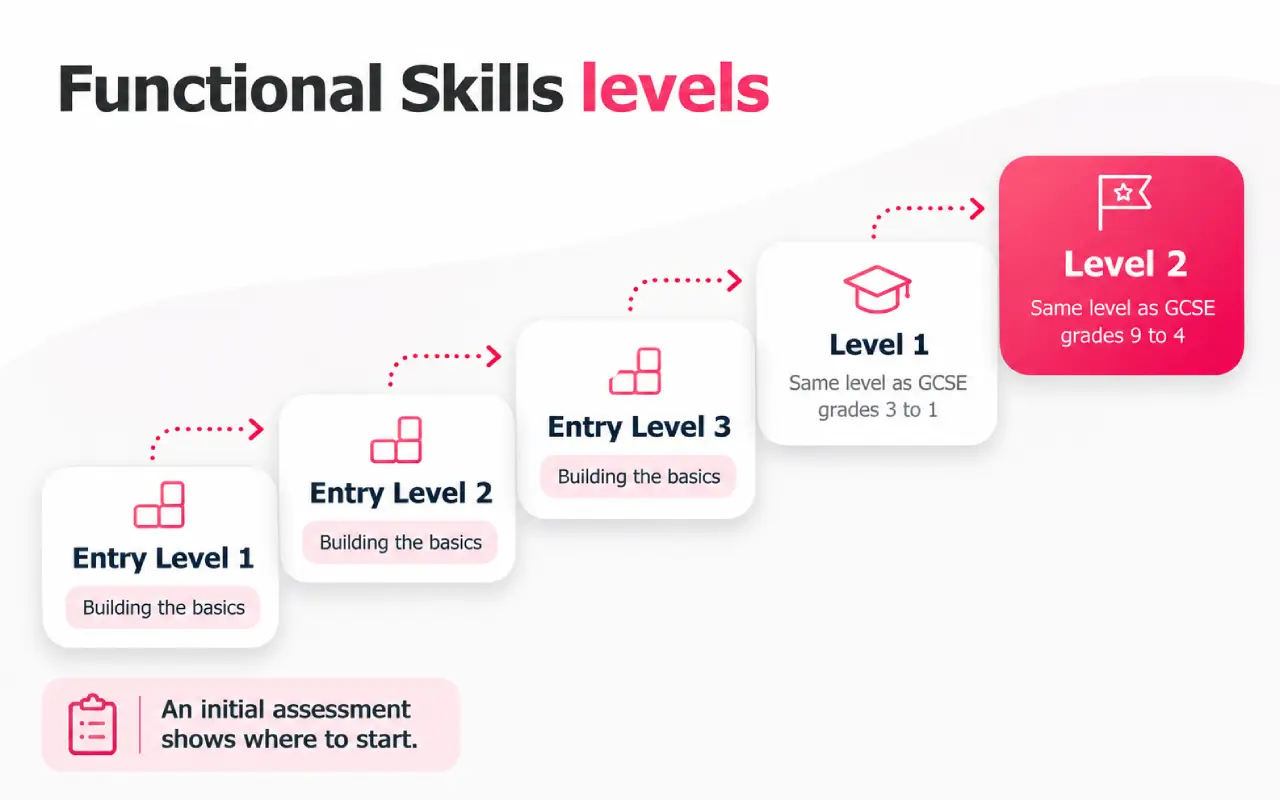
They are regulated qualifications, which means they are offered by approved awarding bodies such as City & Guilds, Pearson and NCFE and overseen by Ofqual, the qualifications regulator in England. There are five levels:
| Functional Skills Level | Same Level As |
|---|---|
| Entry Level 1, 2 and 3 | Below GCSE |
| Level 1 | GCSE grades 3 to 1 (D to G) |
| Level 2 | GCSE grades 9 to 4 (A* to C) |
Most adults aim for Level 2, because that’s the level most employers, colleges and universities ask for.
Functional Skills or GCSE: a quick answer
Both can show you have maths and English at Level 2. GCSEs follow a school-style syllabus with fixed exam dates. Functional Skills focus on real-life use, and exams can often be booked when you’re ready. If you’re still weighing them up, our guide to choosing between Functional Skills and GCSE sets out the pros and cons in detail.
Who takes Functional Skills Level 2, and why?
There’s usually no formal entry requirement, so the qualification suits adults of any age and background. People commonly take it because they:
- need maths and English for a job, especially in care, healthcare support, education or retail management
- want to start an apprenticeship or an Access to Higher Education course
- are applying for a university course that asks for a grade 4 or equivalent
- want to go for a promotion, or simply feel more confident with numbers and writing
- want to help their children with homework
Most employers and colleges accept Level 2, but it’s always worth checking with the organisation you’re applying to. You can also check how Level 2 compares with a GCSE before you apply.
Some careers have their own rules. Nursing degrees, for example, often ask for maths and English at grade 4, so it’s worth knowing the accepted alternatives for nursing first. School support roles have their own expectations too, so check the maths and English teaching assistants need before you choose a level.
Functional Skills or ESOL?
They serve different learners. ESOL (English for Speakers of Other Languages) is for people whose first language isn’t English and who are still building everyday English. Functional Skills English assumes you can already communicate in English and helps you use it accurately for work and study. Some learners do ESOL first, then move on to Functional Skills.
Which level should you start at?
Before you enrol, a college or provider will usually ask you to take an initial assessment. This is a short, low-pressure check of what you can already do, so you start at the right level.
It’s tempting to jump straight to Level 2, but starting too high is one of the easiest ways to struggle. If your assessment suggests Entry Level 3 or Level 1, that isn’t a setback. Entry Level 3 covers the basics (simple fractions, everyday measures, clear sentences), and each level builds the confidence you need for the next.
If you’d like a private check of your maths before speaking to anyone, National Numeracy offers a free numeracy check and practice tool at no cost. It’s a useful way to see where you stand.
What the Level 2 maths and English exams involve
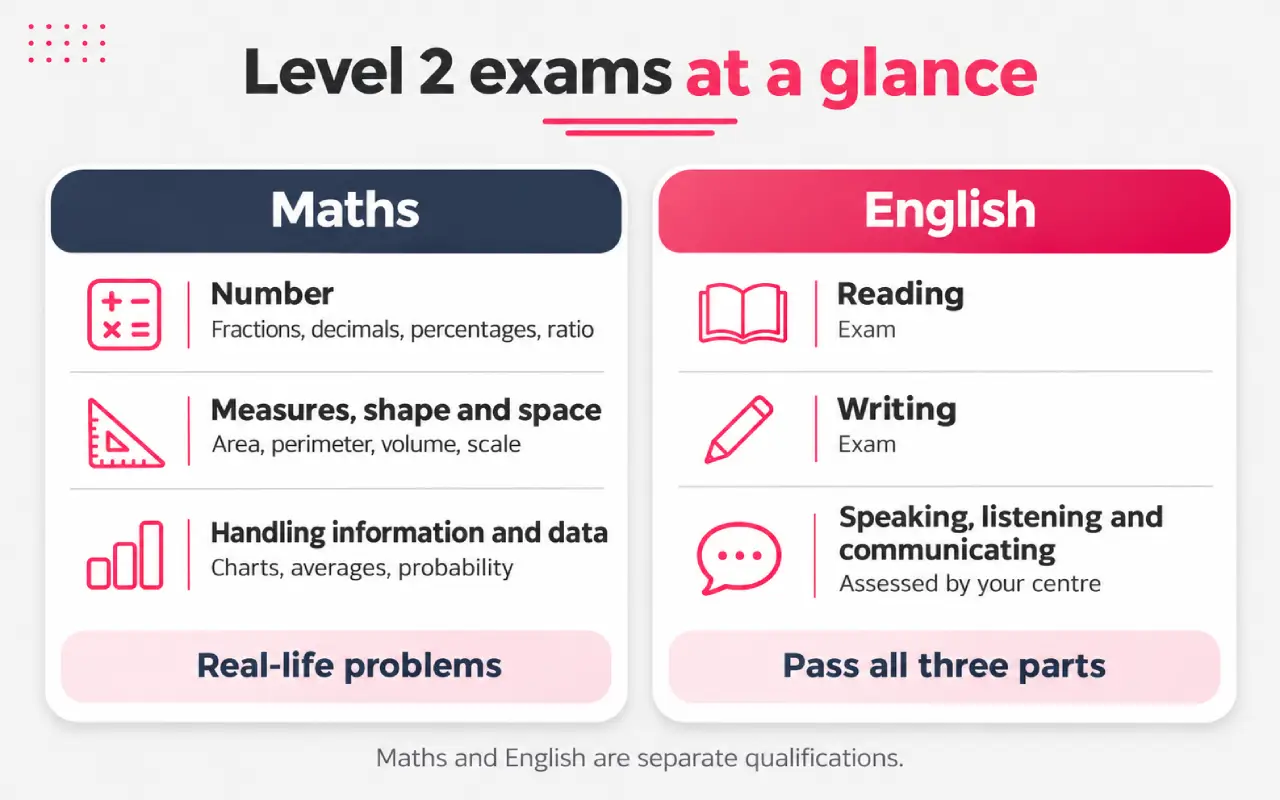
Maths and English are separate qualifications. You can take one, or both, at your own pace.
Maths Level 2
The maths exam tests three broad areas:
- Number: fractions, decimals, percentages, ratio and proportion
- Measures, shape and space: area, perimeter, volume and scale drawings
- Handling information and data: charts, averages and probability
Questions are set in real-life situations, such as planning an event or comparing phone contracts. The exam usually includes a section where you can’t use a calculator, so mental and written methods matter. Depending on your provider, you may take the exam on screen or on paper.
English Level 2
English is split into three parts:
| Component | What It Tests | How It's Assessed |
|---|---|---|
| Reading | Understanding, comparing and judging texts | Exam, externally marked |
| Writing | Clear, organised writing with accurate spelling, punctuation and grammar | Exam, externally marked |
| Speaking, listening and communicating (SLC) | Presenting information and taking part in discussions | Assessed by your centre |
You need to pass all three to achieve the qualification. In the writing exam, spellcheckers are normally not allowed, so accurate spelling counts.
Pass marks and practice papers
There’s no single pass mark for every exam. Each awarding body sets its own, and it can vary between papers. The best preparation is to work through official practice material. City & Guilds, for example, publishes sample papers and mark schemes for its Functional Skills qualifications, and it advises that learners complete practice assessments before booking a real one.
Can adults get Functional Skills for free?
For many adults in England, yes. GOV.UK states that if you’re over 16 and have left school, you normally don’t pay for English or maths courses up to GCSE level. Its further education guidance adds that “in most cases you will not have to pay for level 1 and 2 English and maths courses.”
In practice, adults aged 19 and over who don’t already hold maths or English at Level 2 are usually eligible for a fully funded course at a college or approved provider. Providers still check things like your age, where you live and your existing qualifications, so it’s best to confirm eligibility with them directly.
Free courses are mostly offered by:
- further education colleges
- local council adult education services
- community learning centres and some libraries
- approved training providers
If extra costs such as travel, childcare or equipment are a barrier, you may be able to get help with course costs through Learner Support, which colleges apply for on your behalf.
How to apply for a free course
- Search for local courses using the GOV.UK course search, or contact your nearest college.
- Ask whether its Functional Skills maths or English course is funded for adults.
- Book your initial assessment.
- Enrol, and ask when classes, exams and the English SLC assessment take place.
Free courses tend to follow term dates and may mean attending in person, so they suit some lives better than others.
Your routes to Level 2 compared
There are three main ways to get your Functional Skills Level 2 as an adult. The right one depends on your budget, timetable and how much support you want.
| Route | Typical Cost | Flexibility | Support | Best For |
|---|---|---|---|---|
| College or adult education course | Often free if eligible | Set class times and term dates | Tutor-led, with classmates | Adults who like structure and qualify for funding |
| Online course with exams included | Paid | Study any time; exam booked when ready | Online tutor or resources | Busy adults who want flexibility and one package |
| Self-study, then book the exam only | Exam fees only, plus any revision materials | Fully flexible | Limited | Confident learners who just need the certificate |

Can you study Functional Skills online? Yes. Many providers offer online learning, and some approved exam centres let you sit exams at home under remote invigilation, where a trained invigilator watches you through your webcam. Rules vary by provider, so check what’s included before you pay, especially for the English SLC assessment, which still has to be arranged through an approved centre.
How much it costs and how long it takes
Costs if you’re not eligible for funding
If you don’t qualify for a free place, you’ll pay a private provider. Prices vary widely, so compare like with like. Check whether the price includes:
- the course or revision materials
- the exam itself, and for English, all three components
- remote invigilation, if you want to sit the exam at home
- resit fees, if you need another attempt
A cheap course that excludes the exam can end up costing more than a package that includes it.
How long Functional Skills takes
There’s no fixed timescale, because it depends on your starting point and how much time you can give each week. An adult who just needs a refresher and studies a few hours a week may be ready within a couple of months. Someone starting from Entry Level may need longer, often working through Level 1 first.
A good provider will give you a realistic estimate after your initial assessment. Results timescales also vary by awarding body, so ask your provider when to expect them.
Course or qualification? Check before you pay
This is where many adults get caught out. A preparation course and a regulated qualification are not the same thing:
- A regulated Functional Skills qualification is awarded by an Ofqual-approved awarding body after you pass its exams. This is what employers and universities ask for.
- A preparation, revision or CPD course helps you learn and practise. It can be very useful, but on its own it doesn’t award the Functional Skills qualification.
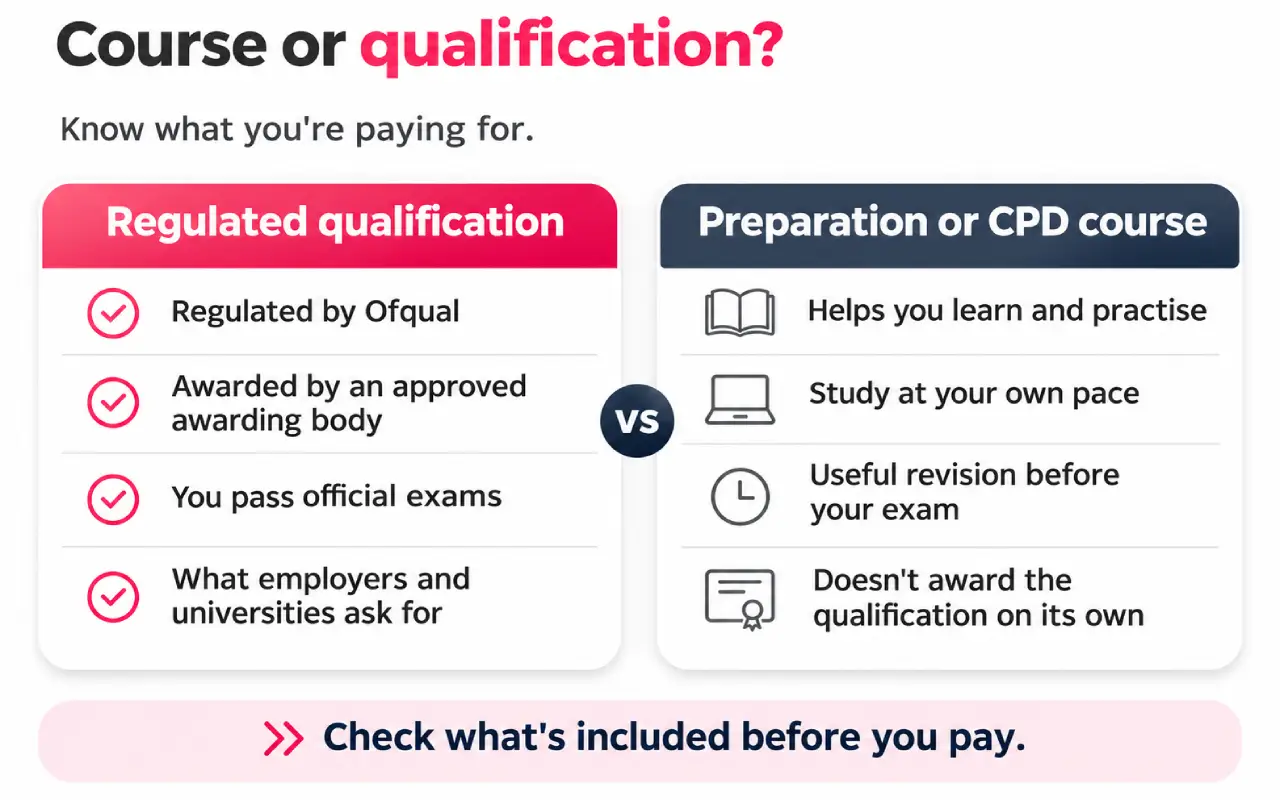
Before paying, ask:
- Is the qualification regulated by Ofqual, and which awarding body is it with?
- Are the exams included, and for English, does that cover reading, writing and SLC?
- Can I sit the exam at home, or do I need to travel to a centre?
- What happens, and what does it cost, if I need to resit?
Clear answers to these questions protect you from paying twice.
How to prepare and pass first time
However you study, a few habits make a real difference:
- Use official practice papers. They show you the question style, timing and what markers look for.
- Practise under exam conditions. Time yourself, and do maths without a calculator for the non-calculator section.
- Focus on weak spots. Percentages, ratio and area catch many adults out in maths. In English, it’s often punctuation and planning.
- Write without a spellchecker. Get used to checking your own work before the exam.
- Read your answer back. For the writing paper, these ways to improve your writing will help you plan clearer, better-organised answers.
If you’d like low-cost, self-paced revision before booking your exam, the Coursegate Functional Skills Maths and English Level 2 course may help. It covers number work, fractions and decimals, percentages, ratio and proportion, rounding and estimation, profit, loss, discount and tax calculations, alongside grammar, sentence structure, punctuation and spelling. It’s a CPD-accredited online course that you can study at your own pace, with a Coursegate CPD certificate available on completion.
To be clear, it is a preparation course, not the Ofqual-regulated Functional Skills qualification. You’ll still need to sit the official exams through an approved centre or provider. Used that way, it’s a flexible way to refresh your maths and grammar before your assessment.
Results, resits and the rest of the UK
If you don’t pass first time, you can resit. In English, you usually only need to retake the component you didn’t pass rather than all three. Ask your provider how soon you can rebook and whether a fee applies.
Functional Skills are the qualifications used in England. Wales and Northern Ireland use Essential Skills, which GOV.UK also lists at Entry Level, Level 1 and Level 2. Scotland has its own framework, so learners there should speak to their local college about the equivalent maths and English options.
Your next step
Getting your maths and English Level 2 as an adult is very achievable once you know the route. Start by checking whether you can study for free at a local college. If that doesn’t fit your timetable, compare online options carefully, making sure the price includes the official exams. Take an initial assessment, practise with real papers, and book your exam when your practice scores are steady. A few focused weeks or months now can open doors to the job, course or confidence you’ve been working towards.
Frequently Asked Questions
Can adults do Functional Skills for free?
Often, yes. In England, adults who have left school and don't yet have maths or English at Level 2 can usually study at a college or approved provider without paying tuition fees. Eligibility depends on factors such as age, residency and existing qualifications, so confirm with your chosen provider.
Can I study Functional Skills online?
Yes. Many providers offer online Functional Skills courses that you can study around work and family. Check whether the course includes the official exams, or whether you'll need to book them separately through an approved centre.
Can I take my Functional Skills exam at home?
Some providers let you sit maths, reading and writing exams at home under remote invigilation, using a webcam and a reliable internet connection. The English speaking, listening and communicating assessment is arranged through your centre, so check how they handle it.
How long does Functional Skills Level 2 take for adults?
It depends on your starting level and weekly study time. Some adults are ready within a couple of months, while others need longer, especially if they start at Level 1. An initial assessment gives you a realistic starting point.
Is Functional Skills Level 2 hard?
It's set at the same level as a GCSE grade 4, so it takes real effort, but the questions are based on everyday situations. Most adults who prepare with practice papers and start at the right level find it manageable.
Do I need to take maths and English together?
No. Functional Skills maths and English are separate qualifications. You can take just one, both at the same time, or one after the other, depending on what your job, course or employer asks for.


- All Courses
- Accounting & Finance64
- Admin, Secretarial & PA45
- Audio Books (Audio Course)100
- Business Skills159
- Design76
- Digital Marketing49
- DIY (Do It Yourself)60
- Employability245
- Food Hygiene & Safety18
- Health & Fitness68
- Health & Safety114
- Health & Social Care191
- Human Resource51
- It & Software Skills116
- Language27
- LIFESTYLE88
- MAKEUP & BEAUTY49
- Management132
- Marketing63
- Massage & Physiotherapy18
- Microsoft Office64
- Nonprofit & Charity36
- On Demand Courses54
- Personal Development142
- Photography34
- Psychology & Counselling99
- SEN (Special Educational Needs)24
- Teaching and Education100