Thinking about taking Functional Skills Level 2 but wondering how difficult it might be? Perhaps you struggled with Maths at school, haven’t studied English for years, or simply want to know what the assessments involve.
Functional Skills Level 2 can be challenging, but it’s manageable with suitable preparation. The difficulty depends on your existing Maths and English knowledge, your confidence and how comfortably you apply skills to practical situations.
Rather than focusing entirely on memorising information, Functional Skills assessments measure how effectively you use what you’ve learnt. Understanding the challenges can help you identify where to focus your preparation.
Ready to Build Your Maths and English Skills?
Strengthen your understanding of essential Maths and English topics with a flexible online course. Study fractions, percentages, ratios, grammar and punctuation at your own pace while preparing for your next learning goal.
Is Functional Skills Level 2 Actually Difficult?
Functional Skills Level 2 requires you to apply Maths and English knowledge independently, accurately and in everyday situations. Although many topics may seem familiar, the questions can require more reasoning than you expect.
For example, calculating 10% of a number is relatively straightforward. However, calculating a discount, adding delivery costs and checking a final price requires several steps.
According to the Department for Education’s Functional Skills Maths subject content, Level 2 assessments involve more demanding problem-solving than Level 1.
The difficulty also varies between subjects. Someone who enjoys working with numbers might find Maths easier than writing formal English. Another learner may have excellent communication skills but need additional practice with calculations.
Knowing what Functional Skills Maths and English Level 2 covers can help you identify which skills you already have and which need further development.
Ultimately, the difficulty is less about your age or previous qualifications and more about your current skills and preparation.
How Hard Is Functional Skills Maths Level 2?
Functional Skills Maths Level 2 can feel demanding when you’re comfortable with individual calculations but less confident about choosing which mathematical methods to use.
The subject includes fractions, percentages, ratios, measurements, data interpretation and practical problem-solving.
Why Multi-Step Maths Questions Can Be Challenging
One of the main challenges is interpreting word problems.
Instead of asking you to calculate a percentage directly, a question might describe a shopping discount, household budget or workplace measurement.
You need to identify the relevant information, choose the correct calculations and check whether your answer makes sense.
Consider this example:
A laptop costs £240 and has a 15% discount. Delivery costs £12. How much will you pay altogether?
Solution:
- Calculate 15% of £240 = £36.
- Subtract the discount: £240 − £36 = £204.
- Add delivery: £204 + £12 = £216.
Final answer: £216.
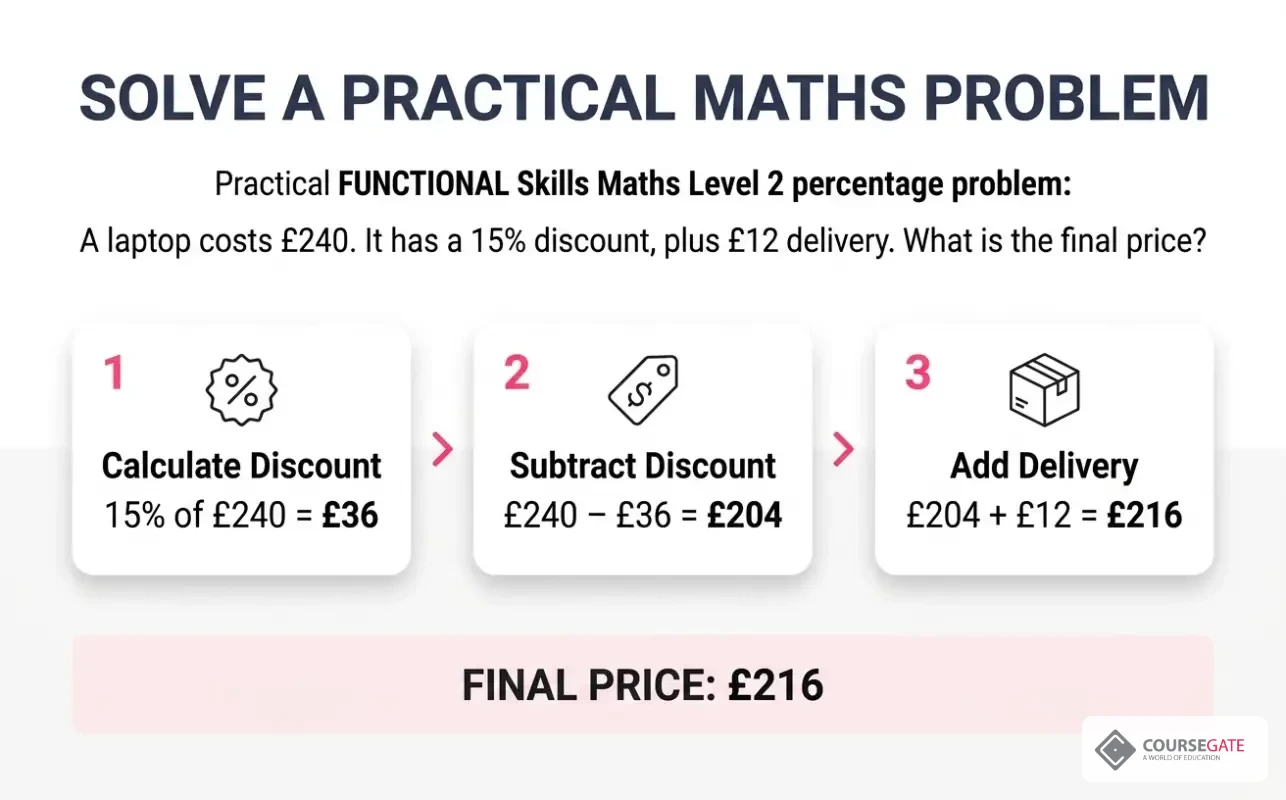
The example demonstrates the type of reasoning involved in practical Maths problems.
The calculations are manageable once you recognise the correct sequence. Practising similar questions can help you become more confident about deciding where to start.
Does the Non-Calculator Section Make Maths Harder?
Some learners find non-calculator questions challenging, particularly when they haven’t practised mental arithmetic recently.
Under Ofqual’s Functional Skills Maths assessment requirements, 25% of the available marks must come from non-calculator tasks, while 75% come from tasks where calculators are permitted. These regulations apply to Functional Skills qualifications in England.
Developing confidence with multiplication, division, fractions and estimation can help you approach non-calculator questions more comfortably.
Even when calculators are permitted, understanding the problem and selecting the correct method remain important.
Is Functional Skills English Level 2 Hard?
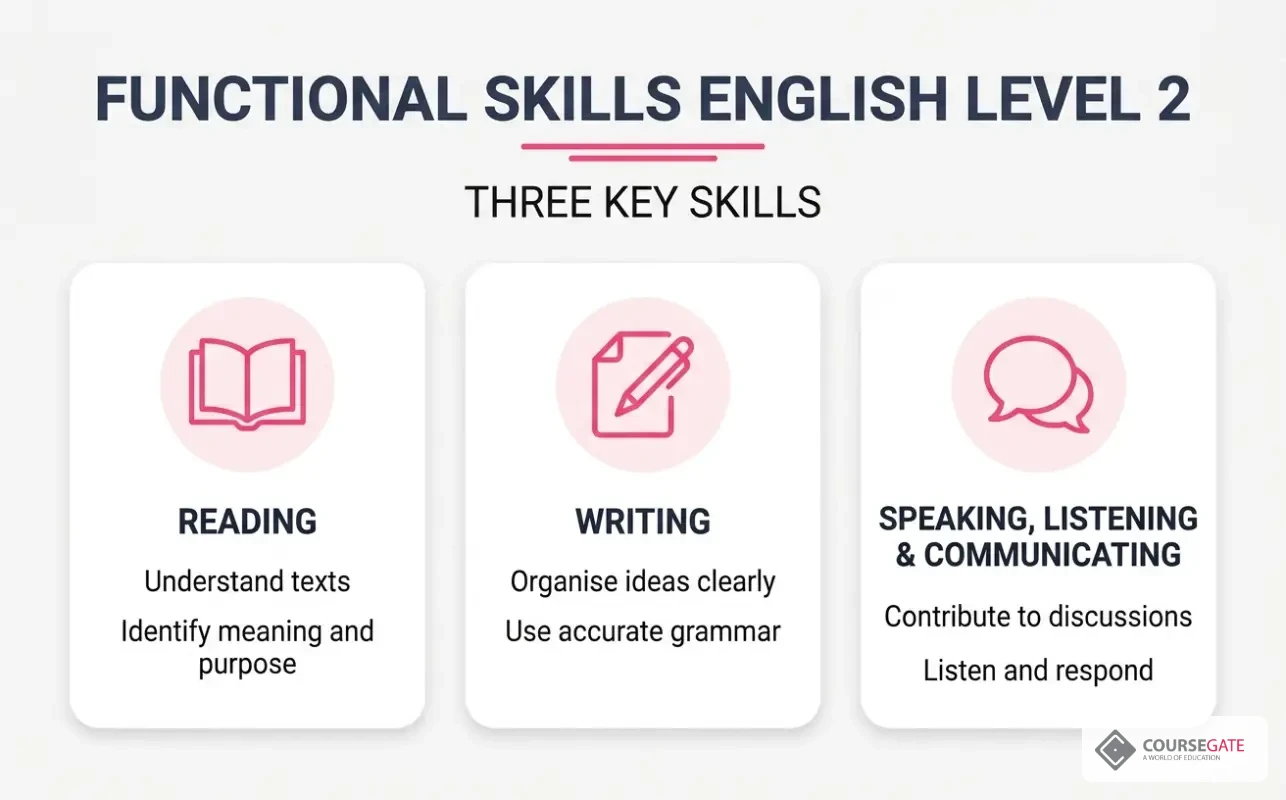
Functional Skills English Level 2 may feel more familiar if you regularly read documents, write emails or communicate with colleagues. However, the assessment requires you to demonstrate specific reading, writing and communication skills.
Reading and Writing Challenges
Reading questions may require you to identify a writer’s purpose, understand implied meaning or compare information from different texts.
Writing tasks assess how clearly you communicate ideas while using suitable spelling, punctuation, grammar and structure.
For example, you might be asked to write a formal email explaining a delivery problem and requesting a solution.
To complete the task effectively, you would need to organise the information logically, choose an appropriate tone and explain your request clearly.
Practising different writing situations helps you become familiar with these expectations.
You can also strengthen your writing skills by practising sentence structure, grammar and clear communication.
Is Speaking and Listening Difficult?
The speaking, listening and communicating component assesses your ability to contribute to discussions, explain opinions, listen carefully and respond appropriately.
According to Ofqual’s Functional Skills English assessment requirements, learners must pass reading, writing, and speaking, listening and communicating at the same level to achieve the regulated qualification in England.
Some learners feel more comfortable speaking than writing, while others prefer having time to organise their thoughts on paper.
Exploring the reading, writing and speaking requirements at Level 2 can help you prepare for each component appropriately.
Is Functional Skills Level 2 Easier Than GCSE?
Functional Skills Level 2 is often viewed as a practical alternative to GCSE Maths or English. However, whether it feels easier depends on your learning preferences and existing knowledge.
According to GOV.UK’s qualification levels, Functional Skills Level 2 and GCSE grades 4–9 sit at the same qualification level within the framework used in England, Wales and Northern Ireland.
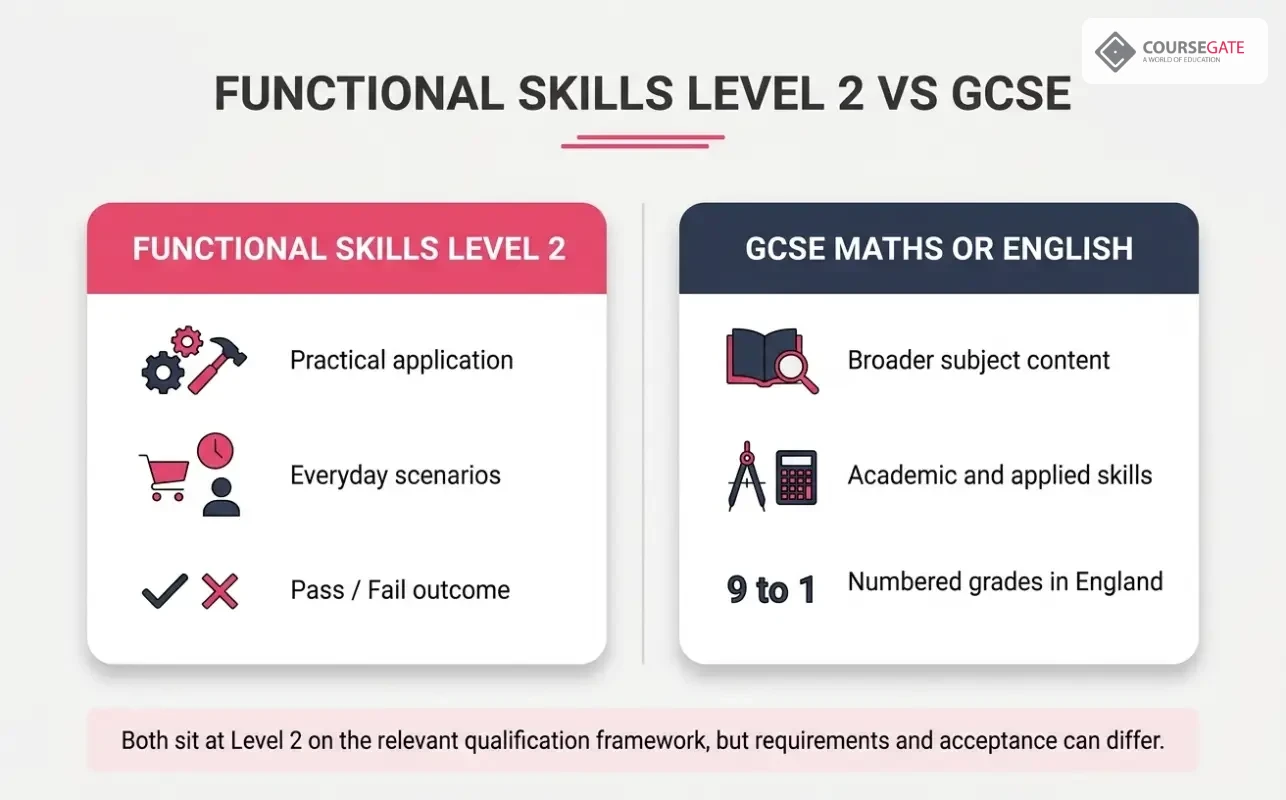
Although they share a framework level, their content and assessment approaches differ.
| Functional Skills Level 2 | GCSE Maths or English |
|---|---|
| Focuses on applying practical skills | Covers a broader subject syllabus |
| Uses everyday situations and applied tasks | Includes academic knowledge and application |
| Uses Pass or Fail outcomes | Uses numbered grades in England |
| May appeal to practical learners | May suit learners pursuing specific academic routes |
If you prefer applying knowledge to real-world situations, Functional Skills may suit your learning style.
However, the qualifications are not automatically interchangeable for every purpose. Some employers, colleges and universities specify particular entry requirements, so checking those requirements before choosing a qualification is worthwhile.
Why Do Some Adults Find Functional Skills Level 2 Hard?
Returning to education as an adult can feel different from studying at school. You may have work commitments, family responsibilities or several years between your last qualification and your next assessment.
These circumstances can influence how you approach learning.
Returning to Maths and English After Several Years
Some common challenges include:
- Refreshing knowledge: Fractions, percentages and grammar rules may need revisiting.
- Finding study time: Work and family commitments can make regular practice harder to organise.
- Getting used to assessments: Timed questions may feel unfamiliar after a long break.
- Understanding question formats: Practical scenarios sometimes require careful reading before calculating or writing an answer.
A useful approach is to identify individual skills that need attention and work through them gradually.
For instance, if you understand percentages but struggle with ratio questions, you can concentrate on ratios rather than revising every Maths topic equally.
Can You Pass If You Struggled With GCSEs?
Yes. Previous difficulties with GCSE Maths or English do not determine how well you can perform in Functional Skills Level 2.
Your knowledge, learning methods and circumstances may have changed since school.
For example, percentages may become easier to understand when you practise them through shopping discounts, budgeting or everyday workplace calculations.
What matters is developing the skills required for the assessment and applying them accurately.
How Can You Tell If You’re Ready for Functional Skills Level 2?
Before beginning structured revision, it helps to understand your current strengths and areas for improvement.
You can start with a few basic Maths and English questions to see how confidently you apply familiar skills.
Try a Short Skills Check Before You Begin
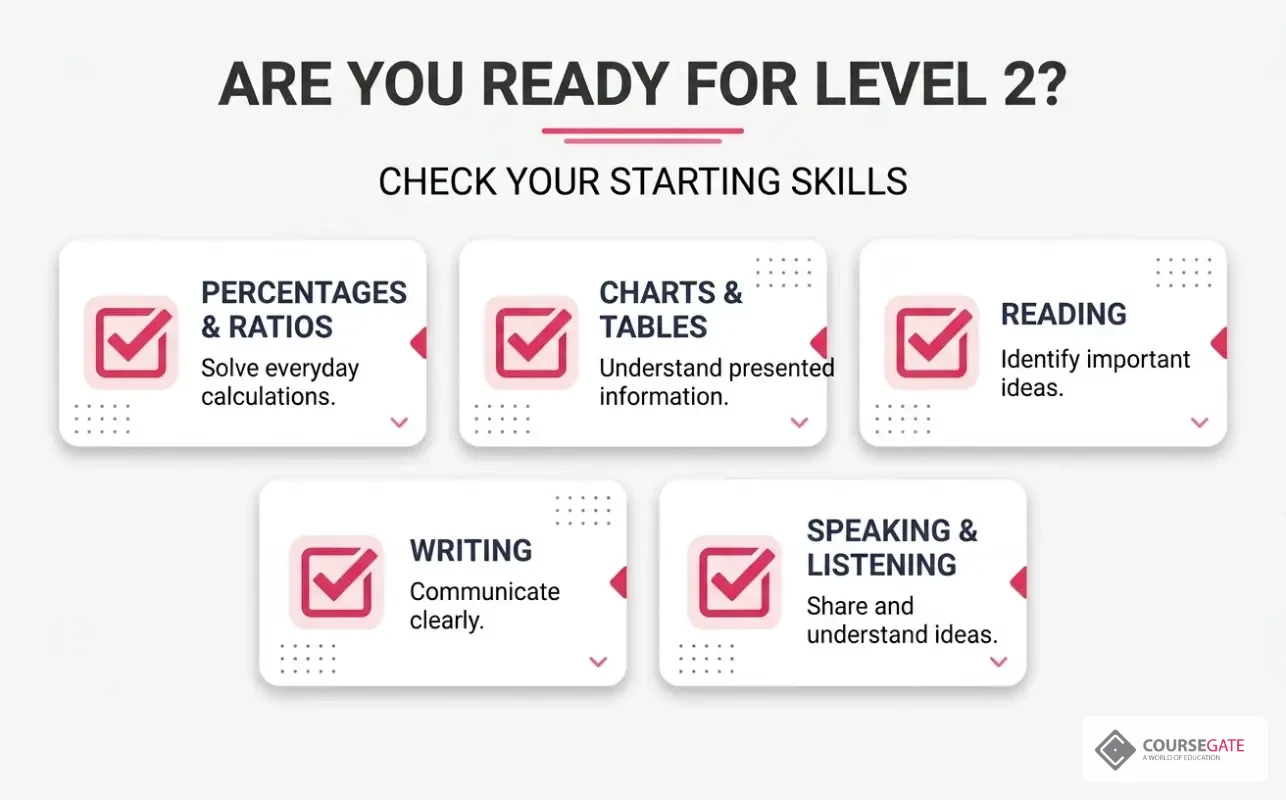
Ask yourself:
- Can I calculate everyday percentages, fractions and ratios?
- Can I interpret information presented in charts or tables?
- Can I explain the steps used to solve a Maths problem?
- Can I identify important information in a written passage?
- Can I write a clear email using suitable grammar and punctuation?
- Can I explain an opinion and respond to questions during a discussion?
These questions provide an informal starting point rather than an official assessment of your ability.
If several areas need attention, revisiting foundational topics can help you prepare for more advanced questions.
A diagnostic assessment or suitable practice paper can provide a clearer understanding of your current level.
Should You Start With Level 1 or Level 2?
You do not generally need to complete Functional Skills Level 1 before progressing to Level 2, although individual training providers may have their own entry arrangements.
If you already understand foundational Maths and English concepts, preparing directly for Level 2 may be appropriate.
Alternatively, revising Level 1 material can help strengthen skills before moving on to more complex tasks.
Understanding how Functional Skills Level 2 pass marks work can also help you prepare, as pass boundaries can vary between awarding organisations and assessment versions.
How to Make Functional Skills Level 2 More Manageable
Good preparation involves identifying what you need to improve and practising those skills consistently.
Instead of revising every topic equally, focus on questions that require more attention.
Here are six practical ways to prepare:
- Identify weaker areas. Use practice questions to find the Maths and English topics that need more work.
- Strengthen foundational skills. Review calculations, reading comprehension and writing accuracy before tackling more complex tasks.
- Practise realistic situations. Work through budgeting problems, measurements, written documents and everyday communication tasks.
- Learn from mistakes. Review incorrect answers to understand the reasoning behind the correct solution.
- Introduce timed practice. Gradually become familiar with completing questions within assessment time limits.
- Build a consistent routine. Regular, focused sessions can make revision easier to fit around daily responsibilities.
Creating a realistic study timetable can help you organise revision sessions around work, family and other responsibilities.
Preparation time varies depending on your existing ability and learning needs. Knowing how long Functional Skills Level 2 preparation may take can help you plan realistic study sessions.
If you prefer structured learning, Coursegate’s Functional Skills Maths and English Level 2 course provides self-paced online training covering mathematical concepts such as fractions, percentages and ratios, alongside English grammar, spelling, punctuation and sentence structure.
The course is CPD-accredited and offers optional paid Coursegate completion certificates. These record completion of the training and are separate from obtaining an Ofqual-regulated Functional Skills qualification through official assessments.
Conclusion: Is Functional Skills Level 2 Manageable?
Functional Skills Level 2 requires preparation, particularly if you’re returning to education or refreshing Maths and English knowledge.
The difficulty depends on your current skills, but understanding the assessment expectations and practising relevant questions can make the process more manageable.
Start by identifying your strengths, reviewing the areas that need improvement and building a consistent study routine. With a clear approach, you can prepare for Functional Skills Level 2 with greater confidence.
Frequently Asked Questions
Is Functional Skills Maths Level 2 Harder Than English?
Neither subject is universally harder. Maths involves numerical reasoning and problem-solving, while English focuses on reading comprehension, accurate writing and effective communication. Your strengths and previous experience will influence which subject feels more manageable.
Can You Fail Functional Skills Level 2?
Yes. Learners must achieve the required assessment standard to pass. For regulated Functional Skills English qualifications in England, all three components must be passed at the same level.
Can You Take Functional Skills Level 2 Without Completing Level 1?
Generally, yes. Level 1 is not a universal prerequisite for Level 2. An initial assessment can help determine whether you’re ready to begin Level 2 preparation or would benefit from reviewing foundational skills first.


- All Courses
- Accounting & Finance64
- Admin, Secretarial & PA45
- Audio Books (Audio Course)100
- Business Skills159
- Design76
- Digital Marketing49
- DIY (Do It Yourself)60
- Employability245
- Food Hygiene & Safety18
- Health & Fitness68
- Health & Safety114
- Health & Social Care191
- Human Resource51
- It & Software Skills117
- Language27
- LIFESTYLE88
- MAKEUP & BEAUTY49
- Management132
- Marketing63
- Massage & Physiotherapy18
- Microsoft Office64
- Nonprofit & Charity36
- On Demand Courses54
- Personal Development142
- Photography34
- Psychology & Counselling99
- SEN (Special Educational Needs)24
- Teaching and Education100