

An SEN teaching assistant vacancy might ask you to adapt learning activities, record pupil progress and support emotional wellbeing. But what do those responsibilities actually look like during a school day?
A typical SEN teaching assistant job description covers one-to-one and small-group learning support, accessible classroom resources, communication with teachers, pupil independence and safeguarding. Some positions also involve specialist communication or personal care.
If you’re considering this role, Course Gate’s Level 3 Teaching Assistant & SEN Certificate offers flexible online learning covering classroom responsibilities, teaching assistant strategies and introductory SEN support. It can help you build relevant knowledge while exploring what schools expect from support staff.
This guide explains the duties and skills employers look for, with practical examples and a real UK school vacancy to help you understand the role before applying.
Already looking at vacancies? Jump to the SEN TA vacancy checker.
Thinking About Becoming an SEN Teaching Assistant?
Build classroom support and introductory SEN knowledge with Course Gate's Level 3 Teaching Assistant & SEN Certificate.
- Teaching assistant responsibilities and classroom strategies
- Supporting pupils with special educational needs (SEN)
- About 3 hours 55 minutes of learning, study at your own pace
What Does an SEN Teaching Assistant Do?
An SEN teaching assistant supports children and young people with special educational needs and disabilities (SEND) to access learning and participate in school activities. Working under teacher direction, they adapt support to individual needs, encourage independence, monitor progress and contribute to a safe, inclusive classroom.
They work in mainstream and specialist schools, supporting individual pupils, small groups or whole-class activities.
The central responsibility is to make learning more accessible without taking over the teacher’s role.
SEN Teaching Assistant Duties and Responsibilities
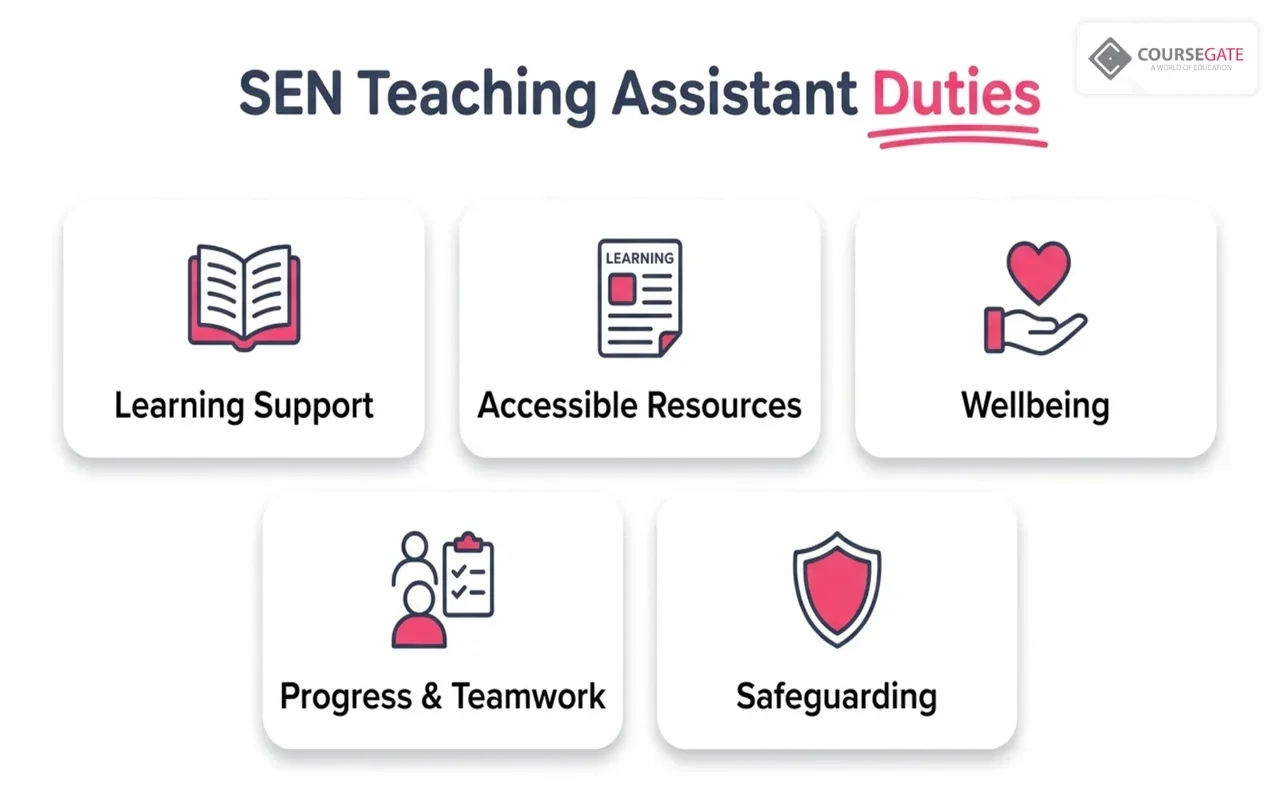
Although responsibilities vary between schools, most SEN teaching assistant duties involve five areas.
1. Provide One-to-One and Small-Group Learning Support
Assistants help pupils understand instructions, participate in lessons and complete teacher-planned activities.
For example, during a maths lesson, an assistant might use counters to explain a problem, ask guiding questions and gradually reduce prompts as the pupil becomes more confident.
The Education Endowment Foundation’s teaching assistant guidance recommends deploying assistants to supplement teaching and develop pupils’ independence.
For more classroom techniques, explore our guide on how to support pupils with SEND in the classroom.
2. Adapt Learning Resources and Communication
Some pupils benefit from visual instructions, adapted worksheets, communication boards or assistive technology.
An SEN teaching assistant might prepare a visual timetable for a pupil who benefits from predictable routines or use picture prompts to support understanding.
These adaptations should follow the pupil’s individual needs and agreed teaching approaches.
3. Support Emotional Wellbeing and Positive Behaviour
Teaching assistants may help pupils manage transitions, understand classroom routines and develop positive relationships.
For example, a pupil who finds noisy environments overwhelming might benefit from an agreed quieter workspace or a planned break.
Assistants follow established support strategies rather than independently deciding disciplinary or specialist interventions.
4. Monitor Progress and Work With School Staff
SEN teaching assistants observe learning, keep appropriate records and share relevant information with teachers and special educational needs coordinators (SENCOs).
In England, they may help deliver support specified in an Education, Health and Care Plan (EHCP).
However, they do not independently assess statutory eligibility or issue EHCPs. These responsibilities fall within England’s SEND statutory framework.
5. Follow Safeguarding and Confidentiality Procedures
An SEN teaching assistant must recognise safeguarding concerns, follow school policies and report concerns promptly through appropriate procedures.
In England, Keeping Children Safe in Education 2026 sets out statutory safeguarding guidance for schools and colleges, including staff responsibilities for reading the relevant guidance and following safeguarding procedures.
Accurate information-sharing, confidentiality and professional boundaries are essential parts of the role.
What Might a Typical SEN Teaching Assistant Day Look Like?
The following example is illustrative. Actual routines depend on the school, pupil needs and employment contract.
| School-day activity | Possible SEN TA responsibility |
|---|---|
| Morning arrival | Help a pupil follow their agreed settling-in routine |
| Literacy lesson | Use visual prompts to support understanding |
| Small-group activity | Reinforce teacher-planned learning |
| Breaktime | Support social interaction or agreed supervision |
| Afternoon lessons | Adapt resources and encourage independent work |
| End of day | Share observations with the teacher and prepare resources |
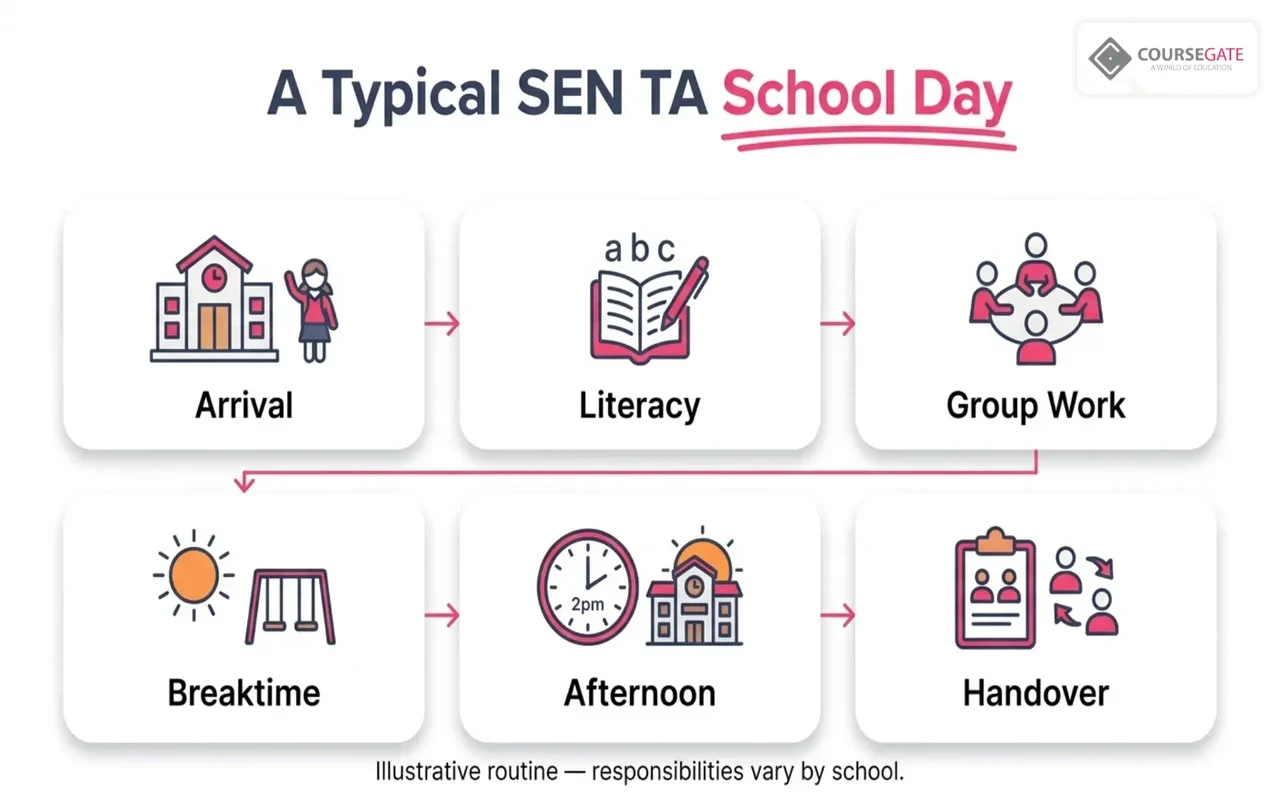
The important detail is not simply what the assistant does, but how they respond to individual needs.
For instance, an assistant may initially model a task, then offer a prompt before allowing the pupil to attempt it independently. This supports learning without creating unnecessary dependence on adult help.
Example SEN Teaching Assistant Job Description
Schools write their own job descriptions according to the pupils they support, staffing arrangements and responsibilities involved.
Here is a simplified example of what a mainstream UK primary school might advertise.
Example Role Summary
Job title: SEN Teaching Assistant
Reports to: Class teacher or designated line manager
Job purpose: Support pupils with special educational needs to participate in learning, develop confidence and become increasingly independent.
Main responsibilities:
- Provide individual and small-group learning support.
- Prepare accessible classroom resources.
- Follow agreed learning and behaviour-support strategies.
- Observe and record pupil progress.
- Communicate appropriately with school staff.
- Promote inclusion, wellbeing and independence.
- Follow safeguarding and confidentiality procedures.
This example is not a standard job description for every school.
Essential and Desirable Skills
A person specification explains what an employer expects from applicants.
| Essential skills — example | Desirable skills — example |
|---|---|
| Clear communication | Previous experience supporting SEND pupils |
| Patience and adaptability | Knowledge of assistive technology |
| Teamwork and organisation | Experience using communication aids |
| Commitment to safeguarding | Relevant teaching assistant training |
Schools may place different requirements in either column.
Before applying, identify examples from your experience that demonstrate the essential criteria.
Preparing for an interview? Take a look at some common SEN teaching assistant interview questions and how to answer them.
What Can a Real UK SEN Teaching Assistant Vacancy Tell You?

A real vacancy can reveal details that general career descriptions overlook.
On 7 September 2026, Ash Field Academy in Leicester advertised an SEN Teaching Assistant position through the government’s Teaching Vacancies service.
The advertisement specified:
- Working pattern: 30 hours per week over 39 weeks, including INSET days.
- Full-time-equivalent salary: £27,717–£29,076 annually.
- Advertised approximate starting salary: £19,227.39 annually for the stated working arrangement.
- Responsibilities: Adapting learning activities, recording pupil progress, supporting wellbeing and working under teacher guidance.
- Experience: Relevant experience with children and an understanding of learning needs.
These figures come directly from the school’s advertisement, rather than an independent pro-rata calculation. Other contracts or pay points may produce different actual salaries.
The example highlights two important points.
First, actual earnings may be lower than the FTE salary because of contracted hours and term-time arrangements.
Second, employers look for specific capabilities, not just positive personal qualities.
When comparing vacancies, check the responsibilities, essential criteria, working hours, actual salary and any specialist support duties before applying.
SEN TA Vacancy Checker: What Does This Job Really Involve?
Have a vacancy open? Tick what its job description mentions to see which duty areas it covers, any specialist duties to ask about and details still missing.
How SEN Teaching Assistant Responsibilities Vary Between Schools
An SEN teaching assistant in a mainstream school may support several pupils throughout the day. In a specialist school, duties may involve more individualised support, communication aids or mobility assistance.
Some positions also include personal care, subject to appropriate training and school procedures.
Similar responsibilities may appear under different job titles, including learning support assistant.
For a closer comparison, read our guide on learning support assistant vs teaching assistant roles.
Qualifications and Training for SEN Teaching Assistants
There is no single Level 3 qualification required for every SEN teaching assistant job.
According to the National Careers Service, individual schools set entry requirements. Many expect GCSE English and maths, while relevant training and experience may strengthen an application.
If you’re thinking about taking the next step, understanding how to become an SEN teaching assistant can help you explore suitable training options and prepare for the role.
To develop relevant background knowledge, Course Gate offers a Level 3 Teaching Assistant & SEN Certificate. This CPD-accredited online course covers classroom responsibilities, teaching assistant strategies, professional standards and introductory SEN support.
It offers a flexible learning option but does not replace employer-specific qualifications, practical experience or safer-recruitment checks.
An SEN teaching assistant plays an important role in supporting learning, inclusion and pupil independence. Understanding the duties and skills involved can help you decide whether the position suits your interests and abilities.
Before applying, take time to review employers’ expectations and identify areas where you could develop your knowledge. Course Gate’s Level 3 Teaching Assistant & SEN Certificate offers flexible online learning covering classroom support, teaching assistant responsibilities and introductory SEN knowledge. It can be a useful starting point for building your understanding of the role.
Ready to Prepare for an SEN Teaching Assistant Role?
Study online with one-year access, covering teaching assistant responsibilities, classroom strategies and introductory SEN support.
- Teaching assistant responsibilities and classroom strategies
- Supporting pupils with special educational needs (SEN)
- About 3 hours 55 minutes of learning, study at your own pace
Frequently Asked Questions
Is Being an SEN Teaching Assistant Hard?
The role can be physically and emotionally demanding, particularly when supporting pupils with complex or changing needs. However, helping pupils develop confidence, independence and communication skills can make the work rewarding.
Do SEN Teaching Assistants Need an Enhanced DBS Check?
School-based SEN teaching assistant roles commonly require an Enhanced DBS check. Whether a children's barred-list check is also appropriate depends on the duties involved. Employers must follow the relevant safeguarding and safer-recruitment requirements.
How Much Do SEN Teaching Assistants Earn in the UK?
The National Careers Service gives a general annual salary range of £19,000–£27,000, from starter to experienced roles. Actual earnings depend on location, contracted hours, employer and whether the position is term-time only.
Do You Need Qualifications to Be an SEN Teaching Assistant?
There is no single qualification required for every SEN teaching assistant position. Schools set their own entry requirements, often considering GCSE English and maths, relevant experience and teaching assistant training. Some employers may prefer candidates with SEND-specific knowledge.
Do SEN Teaching Assistants Help With Personal Care?
Some SEN teaching assistants support pupils with personal care, mobility or everyday routines. However, these duties vary depending on the school and individual pupil needs. Appropriate training, clear responsibilities and school procedures should be in place.


- All Courses
- Accounting & Finance64
- Admin, Secretarial & PA45
- Audio Books (Audio Course)100
- Business Skills159
- Design76
- Digital Marketing49
- DIY (Do It Yourself)60
- Employability245
- Food Hygiene & Safety18
- Health & Fitness68
- Health & Safety114
- Health & Social Care191
- Human Resource51
- It & Software Skills117
- Language27
- LIFESTYLE88
- MAKEUP & BEAUTY49
- Management132
- Marketing63
- Massage & Physiotherapy18
- Microsoft Office64
- Nonprofit & Charity36
- On Demand Courses54
- Personal Development142
- Photography34
- Psychology & Counselling99
- SEN (Special Educational Needs)24
- Teaching and Education100