
Level 3 food hygiene is training designed to develop the food safety knowledge needed for supervisory and management responsibilities. It covers food safety systems, HACCP, contamination prevention, allergens, hygiene procedures and staff supervision. It is particularly relevant to kitchen supervisors, catering managers and food business owners, although a specific Level 3 certificate is not universally required by UK law.
When you’re responsible for a food preparation team, knowing how to handle food safely is only part of the job. You also need to check that procedures are followed, recognise problems and help colleagues maintain safe working practices.
This guide explains what Level 3 training involves, who may benefit, what UK rules require and how to choose appropriate training.
What Is Level 3 Food Hygiene?
Level 3 food hygiene focuses on the knowledge needed to supervise food handling and support food safety management within a business.
While introductory training concentrates on safe everyday practices, Level 3 training generally goes further into managing hazards, monitoring procedures, supervising staff and maintaining food safety standards.
It is relevant to workplaces such as restaurants, cafés, hotels, catering businesses and food production facilities.
However, the exact syllabus, assessment and certificate depend on the training provider and programme.
What Does a Level 3 Food Hygiene Certificate Mean?
A Level 3 food hygiene certificate usually indicates that someone has completed training or a qualification covering food safety at a supervisory level.
Not all Level 3 certificates have the same status.
For example, a CPD certificate records professional development or course completion. A regulated qualification has formal awarding and assessment arrangements.
The government’s qualification records include the Highfield Level 3 Award in Food Safety for Catering, which has an identifiable qualification number and awarding organisation.
The Royal Society for Public Health also offers a separate Level 3 food safety qualification for manufacturing.
Before enrolling, check exactly what the course awards. A CPD certificate should not be mistaken for an Ofqual-regulated qualification.
Who Should Take Level 3 Food Hygiene Training?
Level 3 training is particularly useful for people who supervise food handling, manage hygiene procedures or oversee other employees.
Roles that may benefit include:
- Kitchen supervisors: Checking food preparation practices, cleanliness, storage and daily hygiene routines.
- Head chefs: Supervising kitchen staff and maintaining safe cooking and handling procedures.
- Restaurant managers: Supporting hygiene procedures, staff training and safe food service.
- Food business owners: Understanding food safety risks, management systems and business responsibilities.
- Food production supervisors: Monitoring hygiene and contamination controls within production activities.
Experienced food handlers preparing for supervisory responsibilities may also find Level 3 training useful.
The important consideration is what you are responsible for, rather than your job title alone.
Someone who simply prepares food may need different training from a supervisor who checks temperature records, instructs new employees and responds to food safety problems.
For a more detailed explanation of who needs Level 3 food hygiene training, including specific roles and responsibilities, see the relevant guidance.
Is Level 3 Food Hygiene a Legal Requirement in the UK?
No specific Level 3 food hygiene certificate is universally required by UK food safety law. However, food businesses must ensure that employees receive suitable food hygiene supervision, instruction or training for their work.
This distinction matters because training responsibilities and certificate requirements are not identical.
What Do UK Food Safety Rules Require?
According to GOV.UK’s staff training and hygiene guidance, food businesses must be able to demonstrate that employees have the skills and current training appropriate to their roles.
The guidance confirms that food handlers do not have to hold a food hygiene certificate.
Training and competence can be developed through relevant courses, workplace instruction, self-study and previous experience.
However, staff must still understand how to handle food safely and manage relevant risks.
People responsible for developing and maintaining food safety management procedures must have suitable training to perform those responsibilities.
For supervisors, this can mean understanding how to:
- Check that hygiene procedures are followed.
- Identify potential contamination risks.
- Monitor food safety controls and records.
- Instruct employees in safe working practices.
- Respond appropriately when procedures are not followed.
Employers may also specify particular training or qualifications for certain positions.
The underlying food hygiene responsibilities apply across the UK, although legislation, regulatory guidance and qualification arrangements can differ between England, Scotland, Wales and Northern Ireland.
For example, Food Standards Scotland’s CookSafe guidance describes intermediate training as suitable for managers and supervisors.
The practical lesson: Choose training that matches your responsibilities and check any specific employer requirements rather than assuming a particular certificate is automatically compulsory.
What Does Level 3 Food Hygiene Training Cover?
Level 3 food hygiene training develops a broader understanding of preventing food safety problems and managing hygiene across a workplace.
The exact curriculum varies, but supervisory programmes commonly address the following areas.
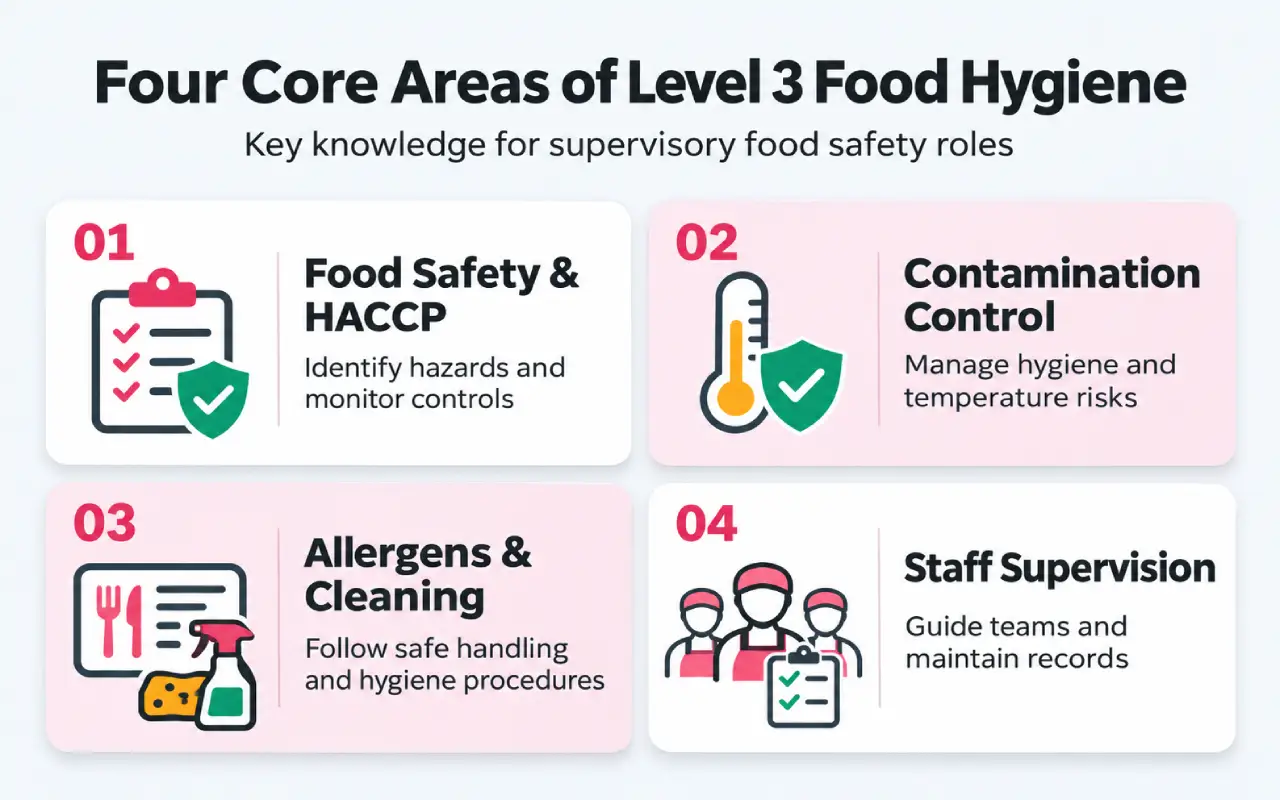
Food Safety Management and HACCP
Food businesses need procedures for identifying and controlling hazards that could make food unsafe.
HACCP stands for Hazard Analysis and Critical Control Points. It is a systematic approach to recognising food safety hazards and establishing suitable controls.
The Food Standards Agency explains the seven HACCP principles, which cover hazard analysis, critical control points, critical limits, monitoring, corrective action, verification and documentation.
At supervisory level, understanding HACCP means more than recognising the abbreviation.
A supervisor may need to check that monitoring takes place, investigate missed controls and make sure relevant records are maintained.
For example, if a refrigeration check identifies a possible problem, the supervisor should follow the business’s documented food safety procedures rather than simply record another temperature.
Food Contamination, Microbiology and Temperature Control
Food can become unsafe through biological, chemical, physical or allergen hazards.
Level 3 training examines how contamination occurs and how workplaces can control it.
Topics commonly include:
- Biological hazards: Harmful bacteria, viruses and other microorganisms.
- Chemical hazards: Cleaning chemicals or other substances that may contaminate food.
- Physical hazards: Foreign materials such as fragments of glass or equipment.
- Cross-contamination: The transfer of hazards between food, people, equipment or surfaces.
- Temperature control: Monitoring storage, cooking, cooling and other relevant food processes.
Supervisors need to understand not just which controls exist, but why those controls matter.
For example, keeping raw ingredients separate from ready-to-eat foods helps reduce cross-contamination risks.
Temperature requirements must be appropriate to the food and process involved. A single temperature rule cannot safely describe every type of food operation.
Food Allergens, Cleaning and Hygiene Procedures
Allergen management is another important supervisory responsibility.
Food businesses must provide appropriate information about regulated allergens and take suitable precautions to prevent unintended allergen cross-contact.
The Food Standards Agency’s food allergen guidance explains relevant information requirements and good handling practices.
Supervisory training may cover checking ingredient information, communicating allergen concerns and ensuring staff follow suitable procedures.
Cleaning and disinfection are equally important.
Supervisors may be responsible for checking that cleaning schedules are followed, equipment is maintained, waste is managed and signs of pest activity are reported.
An effective cleaning routine depends on the correct method, suitable products and employees understanding their responsibilities.
Supervising Staff and Maintaining Food Safety Records
Food safety procedures only work when people apply them consistently.
Level 3 training therefore commonly includes staff supervision, monitoring and record keeping.
A supervisor may need to:
- Explain hygiene procedures to new employees.
- Check cleaning and monitoring records.
- Identify recurring food safety problems.
- Report failures and arrange appropriate corrective action.
- Support employees who need further instruction.
- Review procedures when working practices change.
Records can help demonstrate that controls have been followed and highlight areas requiring attention.
The goal is not simply to complete paperwork. It is to use monitoring and supervision to help prevent unsafe practices.
Level 2 vs Level 3 Food Hygiene: What's the Difference?
The main difference is the level of responsibility the training generally prepares learners to understand.
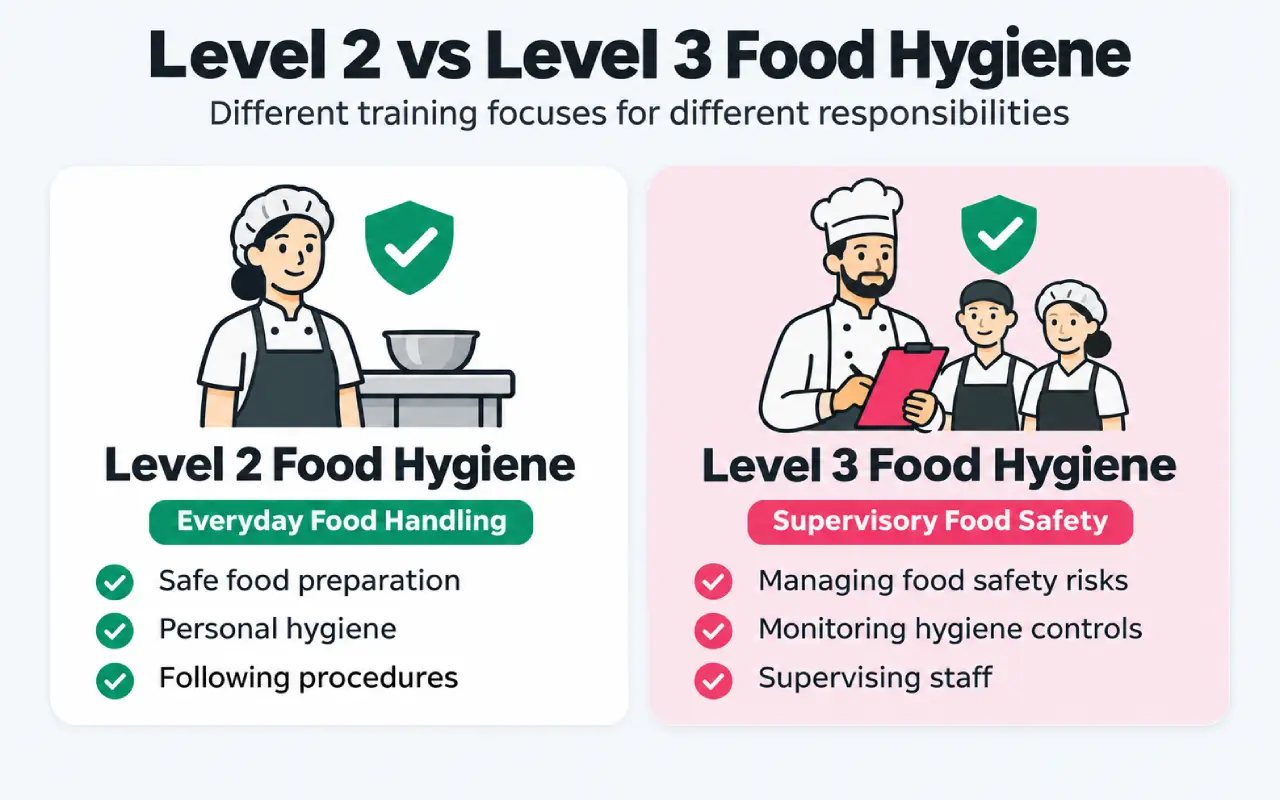
Level 2 focuses on safe food handling, while Level 3 places greater emphasis on supervision and food safety management.
| Feature | Level 2 Food Hygiene | Level 3 Food Hygiene |
|---|---|---|
| Main focus | Safe everyday food handling | Supervisory food safety management |
| Typical audience | Food handlers and preparation staff | Supervisors, managers and team leaders |
| Core knowledge | Hygiene, contamination and safe handling | Hazard management, monitoring and supervision |
| Workplace application | Following established procedures | Helping oversee and maintain procedures |
These are general training distinctions. Individual course specifications and qualification requirements may differ.
If your responsibilities mainly involve preparing or serving food, Level 2 may be appropriate. If you oversee employees or manage hygiene procedures, Level 3 may be more relevant.
A fuller Level 2 vs Level 3 food hygiene comparison can help when deciding which training level suits your role.
How Do You Get a Level 3 Food Hygiene Certificate?
You can take Level 3 food hygiene training online or through an appropriate classroom-based provider.
The right route depends on your responsibilities, the qualification or certificate required and your preferred study format.
1. Choose Training That Matches Your Responsibilities
Start by identifying what you need the training for.
A kitchen supervisor may need broad knowledge of food preparation, allergens and staff hygiene. Someone working in food manufacturing may need training specifically designed around production processes and manufacturing controls.
Check the course syllabus and ask your employer whether a particular qualification, awarding organisation or assessment is required.
2. Complete the Training and Any Required Assessment
Training providers offer different study arrangements, including self-paced online programmes and classroom-based sessions.
Completion times vary depending on the syllabus, depth of study and assessment requirements.
Online learning can be convenient for people working shifts or managing other commitments, but convenience should not be the only deciding factor.
Consider whether the materials explain supervisory responsibilities clearly and whether the training provides suitable evidence of learning.
3. Check What Certificate You Will Receive
Before enrolling, confirm:
- The exact certificate or qualification name.
- Who issues the certificate.
- Whether the programme awards CPD evidence or a regulated qualification.
- Any assessment or completion conditions.
- Whether certificate fees are included.
- Any specific employer or industry recognition requirements.
A course advertised as Level 3 does not automatically award a regulated Level 3 qualification.
If you need a named qualification for work, verify its status before paying.
How Is Level 3 Food Hygiene Used in a Real Kitchen?
Consider a kitchen supervisor checking food safety records before a busy lunch service.
During the review, they notice that a required refrigeration temperature check has not been recorded.

Rather than assuming the refrigerator is working correctly, the supervisor investigates.
They check the current temperature using an appropriate method, establish whether earlier checks were completed and follow the business’s documented procedures for assessing any potentially affected food.
If a food safety control may have failed, the supervisor follows the relevant corrective-action process and escalates the issue when necessary.
They also establish why the record was missed.
Perhaps a new employee was unsure who was responsible for the check. The supervisor can clarify the procedure, provide instruction and ensure responsibilities are understood.
This is an illustrative workplace scenario, not a universal procedure for every refrigeration problem.
It demonstrates an important difference between basic food handling knowledge and supervisory competence.
A food safety supervisor needs to recognise problems, investigate them and help ensure that appropriate controls are maintained.
How to Choose the Right Level 3 Food Hygiene Course
Not every Level 3 course covers exactly the same material or awards the same certificate.
Before choosing training, consider five questions:
- Does the syllabus match your role? Check that the course covers relevant supervisory duties and food safety risks.
- Is it suitable for your industry? Catering, hospitality and manufacturing can have different training needs.
- Can you manage the study commitment? Review the learning format, duration and access period.
- What certificate will you receive? Confirm whether it is CPD evidence, a completion certificate or a regulated qualification.
- What is included in the price? Check for separate certificate charges or other costs.
For learners interested in online supervisory food safety training, Coursegate’s Food Hygiene and Safety Level 3 course covers HACCP, contamination prevention, food hygiene legislation, temperature monitoring, allergens and staff supervision.
The programme currently advertises 11 hours and 27 minutes of learning content and one year of course access.
An optional CPD certificate is available for an additional fee. It records completed professional development rather than awarding a regulated Level 3 qualification.
Check the course details and certificate terms before enrolling, particularly if your employer requests a specific credential.
Final Thoughts
Level 3 food hygiene training is most useful when it reflects the responsibilities you actually carry out.
If you supervise food handling, manage hygiene procedures or support a food safety system, developing this knowledge can help you make better-informed decisions at work.
Before choosing a course, confirm its curriculum, certificate status and relevance to your role. The right training should give you knowledge you can apply, not simply another certificate to add to your records.


- All Courses
- Accounting & Finance64
- Admin, Secretarial & PA45
- Audio Books (Audio Course)100
- Business Skills159
- Design76
- Digital Marketing49
- DIY (Do It Yourself)60
- Employability245
- Food Hygiene & Safety18
- Health & Fitness68
- Health & Safety113
- Health & Social Care191
- Human Resource51
- It & Software Skills116
- Language27
- LIFESTYLE88
- MAKEUP & BEAUTY49
- Management132
- Marketing63
- Massage & Physiotherapy18
- Microsoft Office64
- Nonprofit & Charity36
- On Demand Courses54
- Personal Development142
- Photography34
- Psychology & Counselling99
- SEN (Special Educational Needs)24
- Teaching and Education100