
Every pupil deserves the opportunity to participate, feel included and make progress in the classroom. For teaching assistants (TAs), knowing how to provide the right support can make everyday learning more accessible.
To support pupils with SEND in the classroom, teaching assistants can use clear instructions, visual aids, adapted activities, structured routines and personalised learning strategies. The aim is to remove barriers, encourage independence and help pupils participate alongside their classmates.
This support is increasingly relevant. According to the Department for Education’s 2025/26 special educational needs statistics, 14.8% of pupils in England receive SEN support, while 6.0% have an Education, Health and Care (EHC) plan.
Whether you already work in education or are interested in becoming an SEN teaching assistant, understanding practical classroom strategies is an important starting point.
Here are 20 approaches you can adapt to individual pupils and everyday classroom situations.
Want to Support Pupils With SEND More Confidently?
Learn about SEN support, communication and teaching approaches with Coursegate's SEN Teaching Assistant Diploma.
- SEN support and high-quality teaching for pupils with SEN
- Communication, cognition, SEMH and sensory needs
- About 3 hours of learning, study at your own pace
What Does Supporting Pupils With SEND Involve?
SEND stands for special educational needs and disabilities. Pupils may experience barriers involving communication, learning, emotional wellbeing, physical access or sensory needs.
England’s SEND Code of Practice identifies four broad areas of need:
- Communication and interaction
- Cognition and learning
- Social, emotional and mental health
- Sensory and/or physical needs
These categories help schools plan support, but pupils may have needs across several areas.
Teachers remain responsible for teaching and pupils’ progress. Teaching assistants help deliver agreed support, adapt activities and encourage participation.
For a broader explanation, the guide to day-to-day SEN teaching assistant duties covers the responsibilities associated with the role.
Strategies 1–5: Make Learning Clear and Accessible
Learning becomes more manageable when pupils understand what is expected and have suitable ways to complete their work.
The Education Endowment Foundation (EEF) recommends approaches including explicit instruction, scaffolding and flexible grouping in its guidance on supporting high-quality teaching for pupils with SEND.
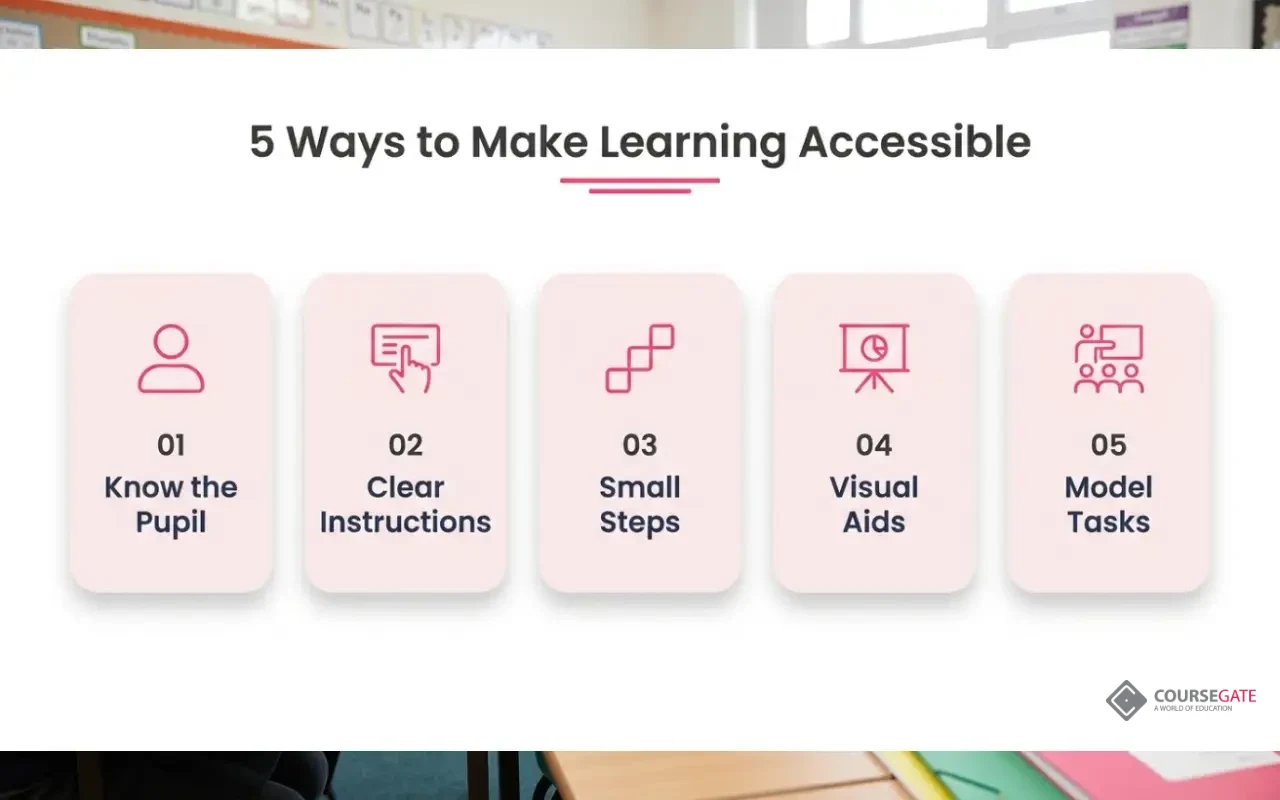
1. Understand Each Pupil's Individual Needs
Start by recognising that pupils with SEND do not all need the same support.
One pupil may struggle with lengthy instructions, while another needs help organising work or communicating with classmates.
Read relevant support plans, speak with the teacher and pay attention to what helps the pupil participate.
Classroom example: A Year 4 pupil finds it difficult to begin writing. Rather than immediately providing answers, the TA offers a simple writing prompt and checks whether the pupil can continue independently.
Small, individualised adjustments are often more useful than applying one technique to everyone.
2. Give Clear and Simple Instructions
Complicated instructions can make tasks harder than necessary.
Use straightforward language, explain what needs doing and avoid giving too many directions simultaneously.
For example, instead of saying, “Open your book, read the passage, underline the keywords and answer the questions,” begin with the first step.
Once the pupil understands it, introduce the next.
Ask the pupil to explain or demonstrate what they will do, rather than simply asking, “Do you understand?”
3. Break Complex Tasks Into Smaller Steps
Long activities can feel overwhelming, particularly when they involve several stages.
Breaking work into manageable sections helps pupils recognise progress.
For a writing task, you might divide the activity into:
- Choose three main ideas.
- Write an opening sentence.
- Develop the first paragraph.
- Check the completed work.
Provide support where needed, but retain the learning objective agreed with the teacher.
The aim is to make the task accessible, not automatically make it easier.
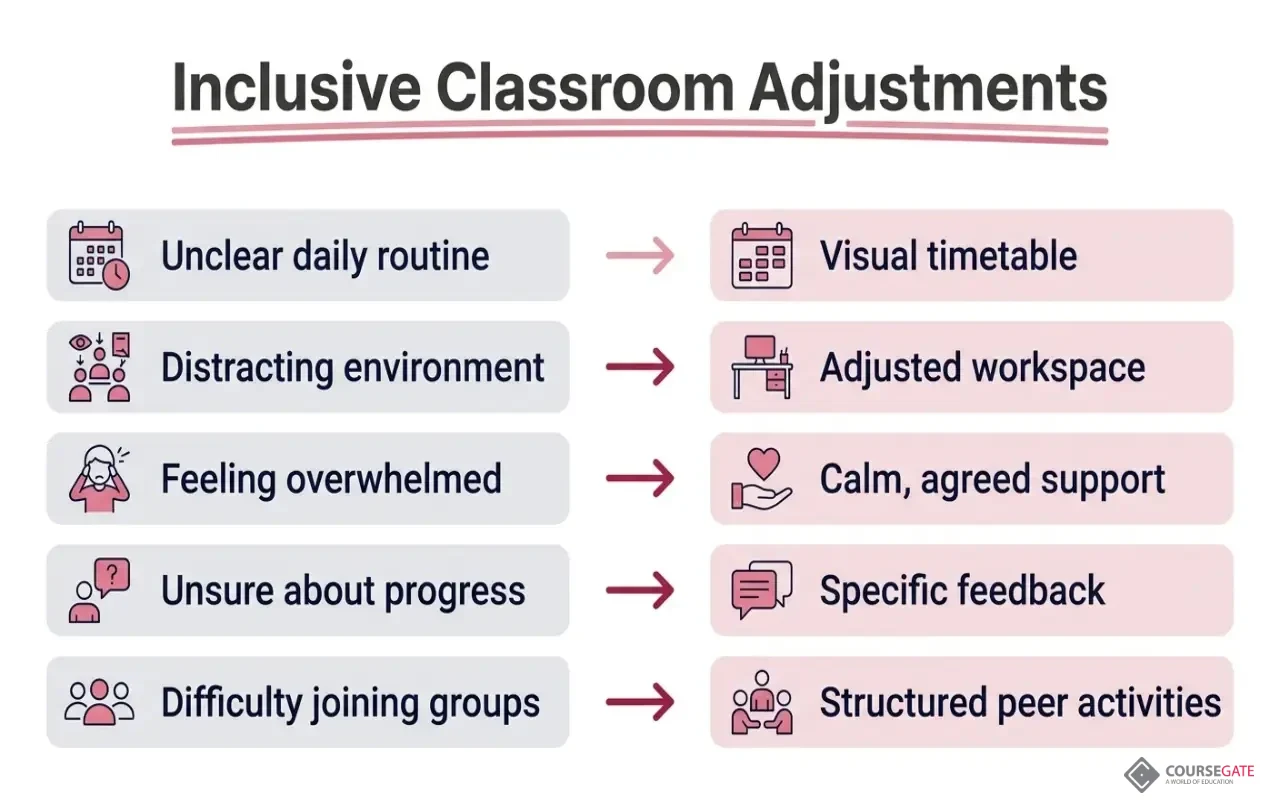
4. Use Visual Supports and Timetables
Visual information can help some pupils follow instructions, remember routines and prepare for changes.
Useful resources include picture schedules, task cards, labelled diagrams and written checklists.
Classroom example: Before moving from maths to reading, show the pupil a simple visual timetable indicating the next activity.
Visual supports should match the pupil’s age, preferences and communication needs. Not every pupil will benefit from the same format.
5. Model Tasks Before Independent Work
Sometimes pupils need to see how an activity works before attempting it.
Demonstrate a task, explain your thinking and guide the pupil through an example.
For instance, solve one maths question while explaining each step. Complete another together before encouraging the pupil to attempt the next independently.
Gradually reducing assistance helps pupils build confidence in their own abilities.
Strategies 6–10: Improve Communication and Participation
Communication is central to inclusive teaching. Pupils need appropriate opportunities to understand instructions, ask questions and demonstrate what they know.

6. Allow Extra Processing Time
Some pupils need longer to understand information and prepare a response.
After asking a question, allow time for thinking. Avoid immediately repeating, rephrasing or answering it yourself.
A short pause may be enough.
Classroom example: During a reading activity, ask a pupil what happened in the story. Give them time to think and offer a written or visual response option if appropriate.
Patience can make classroom communication more comfortable and productive.
7. Teach and Revisit Important Vocabulary
Unfamiliar vocabulary can prevent pupils from understanding lessons, even when they can complete the underlying task.
Introduce essential words before an activity and explain them using accessible language.
Use examples, pictures or demonstrations where helpful.
For instance, before a science experiment, introduce terms such as prediction, observation and result.
Revisit these words throughout the lesson rather than expecting pupils to remember them after one explanation.
8. Adapt Learning Materials for Accessibility
Inclusive teaching strategies often involve changing how information is presented.
Depending on individual needs, adjustments might include:
- Clearer worksheet layouts
- Larger or more accessible text
- Structured writing templates
- Diagrams alongside explanations
- Digital versions of printed resources
Classroom example: A pupil who struggles to organise written answers uses a planning template with separate spaces for their main idea and supporting details.
Keep the intended learning outcome in mind when adapting resources.
9. Use Assistive Technology Where Appropriate
Assistive technology can help pupils access information and demonstrate learning.
Examples include text-to-speech software, speech-to-text tools, accessible keyboards and digital reading aids.
A pupil who finds handwriting difficult, for instance, might use an agreed speech-to-text tool to record their ideas.
Technology should be selected according to individual needs, school arrangements and the learning objective.
It should support participation rather than replace opportunities to develop relevant skills.
10. Check Understanding Without Putting Pupils on the Spot
Some pupils may say they understand an instruction even when they remain unsure.
Instead of asking, “Does everyone understand?”, use quick, low-pressure checks.
Ask a pupil to demonstrate the first step, choose between possible answers or explain what they will do next.
Avoid repeatedly questioning pupils publicly about difficulties they may find embarrassing.
A private, supportive check can reveal whether further explanation is needed.
Strategies 11–15: Create a Supportive and Inclusive Classroom
A welcoming classroom considers pupils’ emotional, social and sensory experiences alongside academic learning.
These SEND classroom strategies help create conditions in which pupils can participate comfortably.
11. Establish Predictable Classroom Routines
Consistent routines help pupils anticipate what will happen during lessons.
Explain the order of activities, give appropriate reminders and prepare pupils for changes.
Classroom example: A pupil who finds transitions challenging receives a reminder shortly before moving from independent work to a group activity.
If the timetable changes unexpectedly, explain the change calmly and provide suitable reassurance.
Predictability can be helpful without making routines unnecessarily rigid.
12. Consider Sensory Needs and the Classroom Environment
Noise, bright lighting, crowded spaces or unexpected movement can make participation difficult for some pupils.
Observe how the environment affects the individual and discuss suitable adjustments with the teacher.
Possible strategies include changing seating arrangements, reducing unnecessary distractions or providing access to an agreed quieter workspace.
For example, a pupil who finds background noise distracting may complete a focused reading task away from a busy classroom area.
Avoid assuming that every autistic pupil or pupil with SEND has identical sensory preferences.
13. Support Emotional Regulation
Pupils may sometimes struggle to manage frustration, uncertainty or overwhelming situations.
A calm, predictable response is often more helpful than increasing verbal demands.
Recognise early signs of distress, use supportive communication and follow the pupil’s agreed support plan.
Classroom example: A pupil becomes frustrated during a difficult activity. The TA acknowledges the difficulty, provides an agreed opportunity to regulate and helps the pupil return to learning when ready.
Teaching assistants should follow school procedures and seek appropriate staff support when necessary.
14. Give Positive, Specific Feedback
Feedback is more useful when pupils understand what they have done successfully and what to try next.
Instead of simply saying, “Good work”, identify a specific achievement.
For example:
“You checked the instructions before starting. That helped you complete the first question independently.”
Recognise effort, appropriate strategies and developing independence without offering excessive praise for every action.
Constructive feedback should guide learning rather than create pressure.
15. Encourage Positive Peer Interaction
Pupils with SEND should have meaningful opportunities to interact and participate with classmates.
Support structured group activities, explain expectations clearly and encourage respectful communication.
Classroom example: During a group science task, a pupil takes responsibility for recording observations while classmates handle other agreed responsibilities.
Adapt group roles when necessary so that everyone can contribute.
Avoid automatically separating pupils from their peers simply because they receive additional support.
Strategies 16–20: Build Independence and Work Effectively With Others
Good classroom support should help pupils become increasingly confident in managing their own learning.
Teaching assistants also need effective communication with teachers and other education professionals.
16. Support Flexible Group Learning
Different activities may require different group arrangements.
A pupil might benefit from a small group when practising a particular skill but participate successfully in a larger group during another activity.
Support the teacher’s planned grouping arrangements while observing what helps the pupil engage.
For example, during collaborative reading, provide a short prompt that helps a pupil contribute to the discussion.
The aim is participation, not creating unnecessary separation from classroom teaching.
17. Encourage Pupil Choice and Independence
Offering appropriate choices helps pupils take ownership of their learning.
Depending on the task, pupils might choose between writing and typing, select a suitable starting activity or decide which resource will help them.
Classroom example: A pupil chooses whether to plan their answer using a mind map or a short list.
Allow them to make the decision and attempt the task without unnecessary intervention.
Choices should remain consistent with the teacher’s learning objectives.
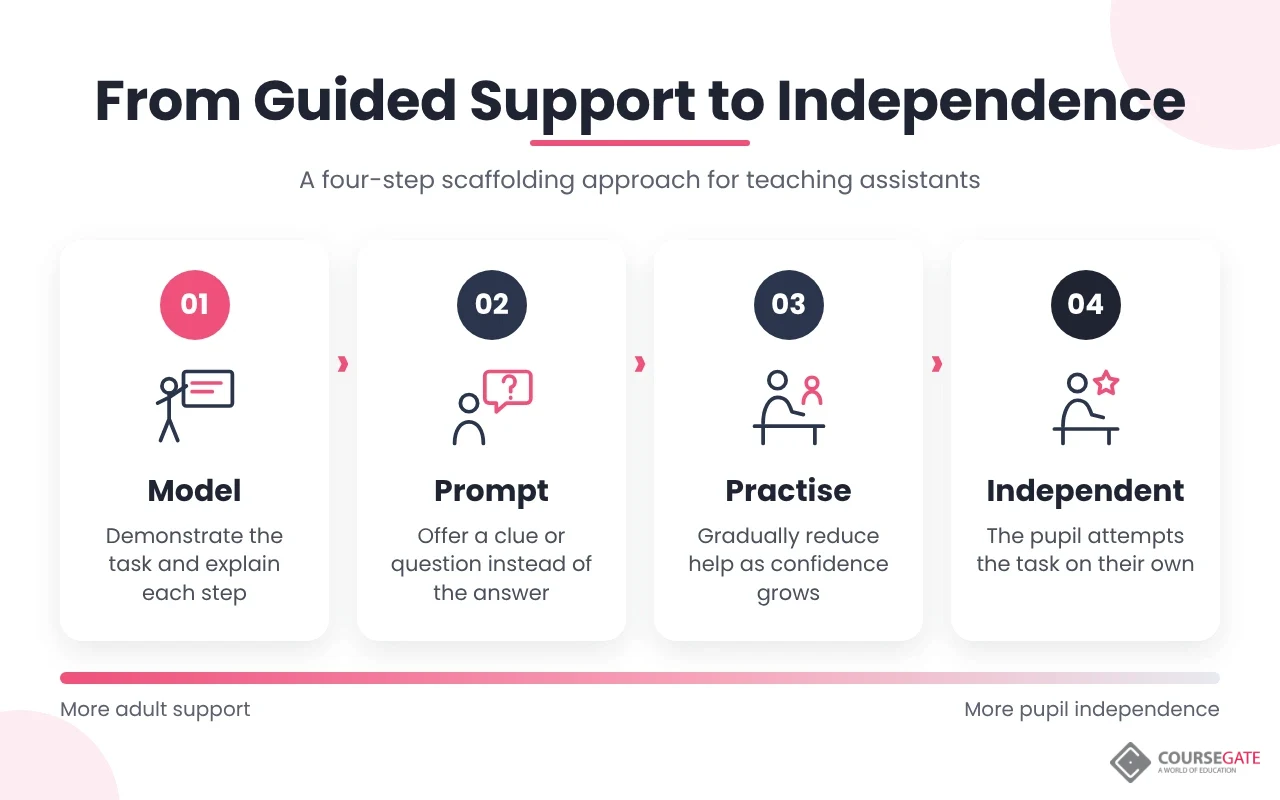
18. Use Scaffolding Without Doing the Work for Pupils
One of the most important teaching assistant strategies is knowing when to offer help and when to step back.
Scaffolding provides temporary support while pupils develop understanding.
Instead of giving the answer immediately, try asking:
- “What have you tried already?”
- “Which example could help?”
- “What do you think comes next?”
If the pupil remains stuck, offer a clue or model the next step.
The EEF’s guidance on effective teaching assistant deployment emphasises using support to develop pupil independence rather than replacing teacher instruction.
19. Communicate Regularly With Teachers and the SENCO
Effective SEND support requires teamwork.
Teaching assistants should share useful observations with the class teacher and follow agreed approaches.
A Special Educational Needs Co-ordinator (SENCO) helps coordinate SEN provision within the school.
Classroom example: A TA notices that a pupil completes reading activities more independently when instructions are presented visually. They share this observation with the teacher so it can inform future planning.
The differences between classroom support roles are also worth recognising, particularly when several members of staff are involved in supporting pupils.
20. Observe Progress and Review What Works
A strategy that helps one pupil may be less effective for another. Needs can also change over time.
Observe how pupils respond to support and record relevant information using school procedures.
Useful observations might include:
- Whether the pupil started work independently
- Which prompts or resources helped
- How successfully they participated
- Whether support could be reduced
- Any barriers that continued
Share observations with the teacher so adjustments can be reviewed.
This reflects the ongoing assess–plan–do–review approach used within SEN support in England.
A Quick SEND Classroom Support Checklist
Before supporting a pupil, consider these five questions:
| Question | What to check |
|---|---|
| Do I understand the pupil's needs? | Strengths, preferences and agreed support |
| Are instructions accessible? | Clear language, visuals and manageable steps |
| Is the pupil included? | Meaningful participation with classmates |
| Am I encouraging independence? | Appropriate prompts without taking over |
| Have I shared useful observations? | Communication with the teacher or SENCO |
A few carefully chosen adjustments are usually more helpful than introducing numerous strategies without a clear purpose.
For readers who want to develop their understanding further, Coursegate’s SEN Teaching Assistant Diploma introduces areas such as SEN support, communication, teaching approaches and monitoring progress.
The online course provides theoretical knowledge and offers a course certificate, with an optional CPD certificate available. It does not itself entitle learners to practise professionally or guarantee employment.
Conclusion: Helping Every Pupil Participate and Progress
Supporting pupils with SEND means choosing practical approaches that improve accessibility, participation and independence.
Teaching assistants can make a valuable contribution through thoughtful adjustments, clear communication and collaboration with teachers.
For aspiring TAs, these classroom examples can also support SEN teaching assistant interview preparation.
Build Your SEN Classroom Support Knowledge
Study online and explore SEN support, the four areas of need and working with school staff, with a course certificate on completion.
- SEN support and high-quality teaching for pupils with SEN
- Communication, cognition, SEMH and sensory needs
- About 3 hours of learning, study at your own pace
Frequently Asked Questions
What Are the Most Effective Strategies for Supporting Pupils With SEND?
Effective approaches include explicit instruction, scaffolding, visual supports, accessible communication and appropriate classroom adjustments. The best strategy depends on the pupil's individual strengths, needs and learning objectives.
How Can a Teaching Assistant Support an Autistic Pupil?
A TA can use clear communication, predictable routines, appropriate visual supports and individual sensory adjustments. Support should reflect the pupil's preferences and agreed school arrangements rather than assumptions about autism.
Can Pupils Receive SEND Support Without a Formal Diagnosis?
Yes. In England, schools can identify learning barriers and arrange appropriate SEN support without waiting for a formal diagnosis. Support should be based on the pupil's individual needs.
How Can TAs Support Pupils Without Making Them Dependent?
Teaching assistants can encourage independence by offering prompts, modelling tasks and gradually reducing help. Allowing pupils time to think, make choices and attempt work independently is particularly important.


- All Courses
- Accounting & Finance64
- Admin, Secretarial & PA45
- Audio Books (Audio Course)100
- Business Skills159
- Design76
- Digital Marketing49
- DIY (Do It Yourself)60
- Employability245
- Food Hygiene & Safety18
- Health & Fitness68
- Health & Safety114
- Health & Social Care191
- Human Resource51
- It & Software Skills117
- Language27
- LIFESTYLE88
- MAKEUP & BEAUTY49
- Management132
- Marketing63
- Massage & Physiotherapy18
- Microsoft Office64
- Nonprofit & Charity36
- On Demand Courses54
- Personal Development142
- Photography34
- Psychology & Counselling99
- SEN (Special Educational Needs)24
- Teaching and Education100